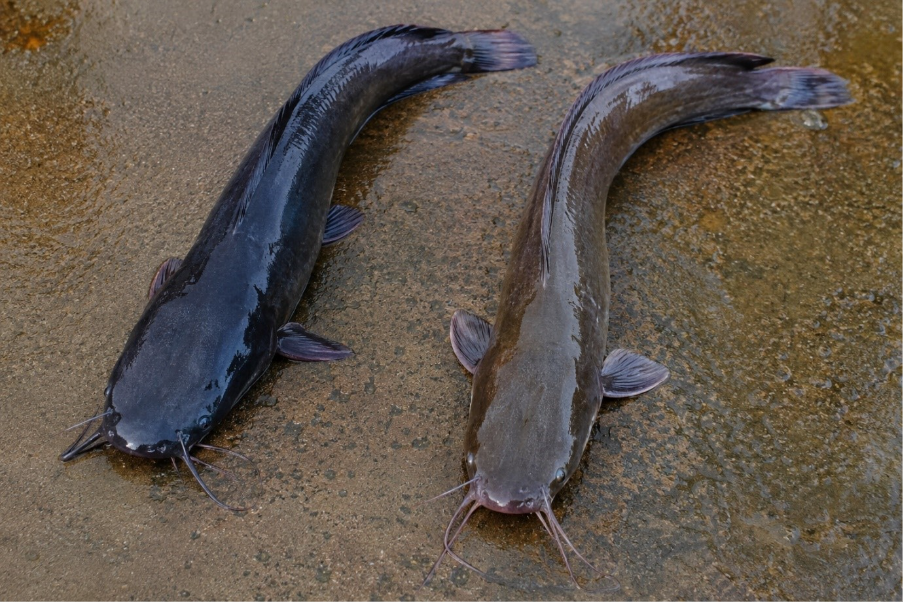
Magur is one of India’s most popular freshwater fish, valued for its taste, nutrition, and market demand. However, many consumers are unaware that not every fish sold as “Magur” is the same. Two species commonly create confusion in the market—Desi Magur (Clarias batrachus), India’s native catfish, and Thai Magur (Clarias gariepinus), also known as the African Catfish.
Since both species look similar, buyers often mistake one for the other. But the difference is important. Desi Magur is an indigenous fish that can be cultured under applicable fisheries regulations, while Thai Magur has been prohibited for breeding and farming in India because of concerns about its impact on native ecosystems.
Knowing how to distinguish between these two species helps consumers make informed choices and enables fish farmers to follow responsible and legal aquaculture practices.
What Is Thai Magur?
Thai Magur (Clarias gariepinus), commonly known as the African Catfish, is an exotic freshwater fish native to Africa. It was introduced into India during the 1990s because of its fast growth, high survival rate, and ability to tolerate poor water quality.
One of its unique characteristics is its ability to breathe atmospheric air through a specialized respiratory organ. This allows it to survive even in low-oxygen conditions where many other fish cannot. These qualities initially made it attractive for commercial aquaculture.
However, the same characteristics also raised serious environmental concerns. Thai Magur is a highly adaptable and aggressive predator that can spread into natural water bodies if it escapes from farms, posing risks to native aquatic biodiversity.
What Is Desi Magur?
Desi Magur (Clarias batrachus) is India’s native catfish species and has been part of traditional aquaculture and local food culture for generations. It is known by different regional names across the country and is widely appreciated for its flavour, nutritional value, and strong market demand.
Compared to Thai Magur, Desi Magur grows more slowly and usually reaches a smaller size. Although its production cycle is longer, it generally fetches a better market price because of consumer preference. Farming of Desi Magur is permitted under applicable fisheries regulations, making it a suitable choice for sustainable aquaculture.
Thai Magur vs Desi Magur: Key Differences
| Feature | Thai Magur | Desi Magur |
| Scientific Name | Clarias gariepinus | Clarias batrachus |
| Origin | Africa | India |
| Legal Status | Breeding and farming prohibited in India | Legal under applicable regulations |
| Growth Rate | Very fast | Moderate |
| Adult Size | Often grows to 1–2 kg or more | Usually remains much smaller |
| Head Shape | Broad, flat, and wide | Narrower and more pointed |
| Body Colour | Dark black or slate grey | Brownish to greyish-black |
| Market Price | Usually lower | Generally higher |
Why Is Thai Magur Prohibited in India?
The prohibition on Thai Magur is mainly based on environmental concerns.
Thai Magur is an aggressive carnivorous fish that feeds on smaller fish, fish eggs, frogs, aquatic insects, and other aquatic organisms. If it escapes into rivers, lakes, ponds, or reservoirs during floods or accidental releases, it can compete with and prey upon native fish species, disrupting the ecological balance of natural water bodies.
To reduce these risks, breeding and farming of Thai Magur have been prohibited in India under applicable regulations.
Health Concerns Are Mostly Linked to Illegal Farming Practices
Health concerns associated with Thai Magur are generally related to illegal farming practices rather than the species itself.
Authorities have reported instances where illegally farmed fish were allegedly reared under unhygienic conditions and fed unsuitable waste materials to reduce production costs and accelerate growth. Fish raised in polluted environments may accumulate contaminants that can affect product quality and raise food safety concerns.
Consumers are therefore advised to buy fish only from trusted vendors who source their products from legal and hygienic aquaculture systems.
How to Identify Thai Magur in the Market
Although both species appear similar, a closer look can help distinguish them.
Head Shape: Thai Magur has a broad, flat, and comparatively larger head, whereas Desi Magur has a narrower and slightly pointed head.
Body Colour: Thai Magur is generally dark black or slate grey, while Desi Magur usually has a lighter brownish to greyish-black appearance.
Size: Thai Magur grows rapidly and is commonly sold at weights of 1–2 kg or more. Desi Magur generally remains smaller and is marketed at lower body weights.
Price: Thai Magur is often available at lower prices due to its rapid growth and lower production cost. Desi Magur usually commands a premium because of its slower growth and higher consumer preference.
Is Every Magur Illegal?
No.
A common misconception is that all Magur fish are prohibited in India. This is incorrect.
Desi Magur (Clarias batrachus)
- Indigenous Indian catfish
- Farming permitted under applicable regulations
- Highly valued by consumers
Thai Magur (Clarias gariepinus)
- Exotic African catfish
- Breeding and farming prohibited in India
- Illegal cultivation may attract legal action under relevant laws
Understanding this distinction is important for consumers, traders, and fish farmers alike.
Advice for Fish Farmers
Fish farmers should avoid culturing prohibited species and instead focus on legally approved aquaculture practices.
Suitable alternatives include:
- Desi Magur (Clarias batrachus)
- Pangasius
- Tilapia
Before starting commercial culture of any species, farmers should consult their respective State Fisheries Department regarding current regulations, approved seed sources, and licensing requirements.
Tips for Consumers
Consumers can make informed purchasing decisions by following a few simple precautions:
- Buy fish only from reliable and reputable sellers.
- Be cautious if Magur is being sold at unusually low prices.
- Learn the visible differences between Thai Magur and Desi Magur.
- Report suspected illegal sale of prohibited fish species to the local Fisheries Department or concerned authorities.
Conclusion
At first glance, Thai Magur and Desi Magur may look almost identical, but they differ significantly in their origin, legal status, growth characteristics, and environmental impact.
Desi Magur (Clarias batrachus) is India’s native catfish and continues to play an important role in sustainable aquaculture. Thai Magur (Clarias gariepinus), on the other hand, is an exotic species whose breeding and farming have been prohibited in India because of its potential ecological risks.
Greater awareness among consumers, traders, and fish farmers can help prevent the illegal trade of prohibited species while encouraging responsible aquaculture and protecting India’s rich aquatic biodiversity.
Keywords: Thai Magur, Desi Magur, African Catfish, Clarias gariepinus, Clarias batrachus, Fish Identification, Illegal Fish Farming, Aquaculture in India, Native Fish Species, Sustainable Aquaculture.