• E – Magazine
    • Aquaculture
    • Aqua Health & Disease Management
    • News
      • National
      • International
    • Farming
    • Research and Innovation
    • Sustainability
    • Technology & Equipments
    • This is Africa
    • Trade
  • Publications
  • Events
    • Expos
    • Trainings
    • Events by Month
  • Business Listings
    • List Your Business
    • Business Listings
    • Buy & Sell
    • Get Consultation
  • Employment
  • About Us
    • Founder
  • Contact
Fishery News
Home » Aquaculture » Page 3
Category:

Aquaculture

Bihars Pearl Farmers Forge New Frontiers in Aquaculture
Aquaculture

Bihar’s Pearl Farmers Forge New Frontiers in Aquaculture

by Fishery News 29/01/2024
written by Fishery News

In a state primarily known for agriculture, a burgeoning group of enterprising farmers, including a notable female presence, is venturing into the realm of pearl farming, signalling a promising shift in Bihar’s agricultural landscape. Despite initial challenges, these pioneers are witnessing remarkable success, spurred by innovative techniques and perseverance.

With the majority of Bihar’s population engaged in traditional agriculture, the emergence of alternative ventures like pearl farming offers a lucrative avenue for economic growth. Currently, the state boasts approximately 25 pearl farmers, with the majority concentrated in the Nalanda and West Champaran districts.

Madhu Patel, a trailblazing mother of two, exemplifies the transformative potential of pearl farming. Armed with determination and modern agricultural knowledge, Patel’s journey began with overcoming setbacks, eventually leading to an annual income ranging from ₹12 lakh to ₹15 lakh. Her success underscores the viability of pearl farming as a profitable venture in Bihar.

Similarly, Nitil Bhardwaj, hailing from Bagha in West Champaran, transitioned from a private sector job to pearl farming, achieving an impressive annual turnover of ₹40 lakh. Bhardwaj’s story reflects the allure of aquaculture as a sustainable livelihood option.

However, pearl farming is not without its challenges. The intricate process involves meticulous care and attention, from nurturing oysters to harvesting pearls. Despite the laborious nature of the endeavour, farmers like Bhardwaj are optimistic about its potential to generate employment opportunities and mitigate rural migration.

While government support in the form of subsidies and infrastructure development could further bolster the pearl farming sector, farmers lament the lack of adequate marketing avenues within Bihar. Despite this hurdle, they remain undeterred, driven by the prospect of higher returns and lower susceptibility to natural disasters compared to traditional farming practices.

With continued dedication and support, Bihar’s pearl farmers are poised to carve a niche within the aquaculture industry, contributing to the state’s economic diversification and rural development initiatives.

29/01/2024 0 comment
0 FacebookTwitterPinterestEmail
ICAR Central Coastal Agricultural Research Institute Promotes Ornamental Fish Culture in Goa
Aquaculture

ICAR-Central Coastal Agricultural Research Institute Promotes Ornamental Fish Culture in Goa

by Fishery News 23/01/2024
written by Fishery News

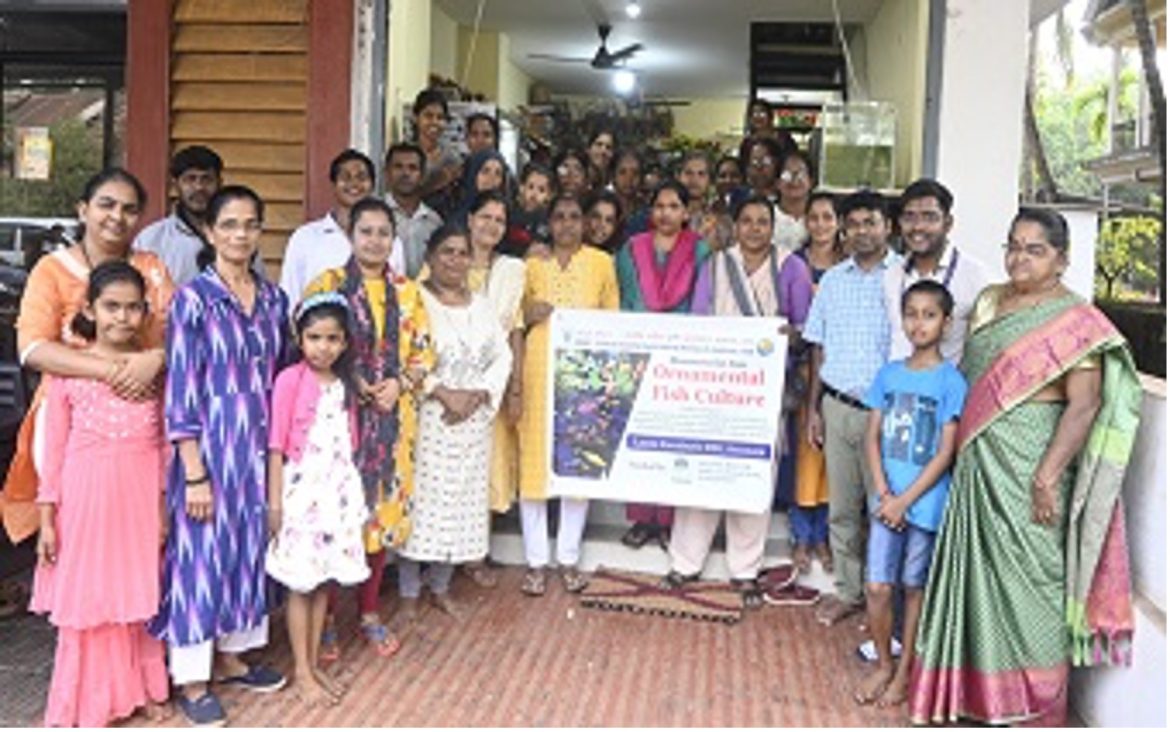
In a step towards promoting entrepreneurship and improving livelihoods, the ICAR-Central Coastal Agricultural Research Institute in Goa organized an exposure visit to Ornamental Fish Culture Units in Cumbarjua.

The initiative is part of the NABARD-funded project titled “Entrepreneurship Development and Livelihood Improvement through Demonstration and Training of Sustainable Ornamental Fish Culture in Goa.” The visit aimed to provide valuable insights into establishing an Ornamental Fish unit through direct interaction with entrepreneurs.

Approximately 20 women members of the Laxmi Ravalnath Self Help Group from Assonara actively participated in the program. The session covered a comprehensive range of topics related to ornamental fish culture, including tank fabrication, water quality management, disease identification, medication usage, feeding techniques, breeding methodologies, marketing strategies, and ornamental fish packaging.

The initiative seeks to empower local communities and enhance their skills in sustainable ornamental fish farming, contributing to economic development and livelihood improvement in the region.

23/01/2024 0 comment
0 FacebookTwitterPinterestEmail
TERI and Bennet Bernard Collaborate to Boost Aquaculture Initiatives in Goa
Aquaculture

TERI and Bennet & Bernard Collaborate to Boost Aquaculture Initiatives in Goa

by Fishery News 09/01/2024
written by Fishery News

The Energy and Resources Institute (TERI) has joined forces with real estate developer Bennet and Bernard Custom Homes to foster and advance aquaculture projects in Goa. The collaboration aims to leverage TERI’s research expertise in sustainable development and aquaculture, combining it with Bennet & Bernard’s local support and resources.

As part of the partnership, TERI will contribute research insights and assist in the development of hatcheries, nurseries, and cultivation processes for various aquaculture fish and plant species. The institute will also undertake training programs for local employees, enhancing their skills in aquaculture practices.

Dr. Fraddry D’souza, Area Convenor of the Coastal Ecology and Marine Resources Centre at TERI, emphasized the significance of harnessing local human and natural resources for societal well-being. He expressed optimism that the collaboration with Bennet and Bernard would not only contribute to social development but also foster economic growth in the region.

Lincoln Bennet Rodrigues, Chairman and Founder of the Bennet & Bernard group, highlighted his company’s commitment to creating a sustainable and self-reliant society. The collaboration with TERI is viewed as a progressive step towards establishing a self-sufficient community across Goa and its surrounding areas.

Under the partnership, Bennet and Bernard will provide financial support, resources, logistical assistance, and local backing, while TERI will bring its extensive expertise and knowledge in aquaculture to the table. The collaboration aligns with Bennet & Bernard’s broader efforts in the well-being sector and its dedication to sustainable community development.

TERI, recognized globally as a leading think tank, specializes in conducting research on sustainable development, with a particular focus on addressing climate change challenges in India and the Global South. The International Centre for Climate Governance has ranked TERI among the top five most impactful think tanks worldwide.

This collaborative initiative holds promise for the advancement of aquaculture practices in Goa, showcasing the potential for merging research capabilities with local support to drive sustainable and economically beneficial projects.

09/01/2024 0 comment
0 FacebookTwitterPinterestEmail
ICAR CIFRIs Innovative Pen Culture Technology Boosts Fishery in Mapithel Reservoir Manipur
Aquaculture

ICAR-CIFRI’s Innovative Pen Culture Technology Boosts Fishery in Mapithel Reservoir, Manipur

by Fishery News 09/01/2024
written by Fishery News

The tribal fishers in Manipur’s Mapithel Reservoir demonstrated the effectiveness of Integrated Multi-Trophic Aquaculture (IMC) fingerling raising using Pen Culture technology. The initiative, undertaken by the ICAR-Central Inland Fisheries Research Institute (ICAR-CIFRI), aimed at enhancing fisheries and promoting sustainable resource management in the region.

Manipur, with 41% of its population belonging to Scheduled Tribes, heavily relies on agriculture, contributing 50-60% to the state’s GDP. Despite the state’s considerable water resources potential, only 32.94% of areas have been developed for fisheries. More than 95% of Manipur’s population consumes fish, leading to significant fish imports from other Indian states.

The Mapithel Dam, the largest reservoir in Manipur, has posed challenges for the tribal population, displacing over 12,000 people. To support the livelihoods of the affected Tangkhul tribe, ICAR-CIFRI provided two Pen HDPE pens, 50,000 fish seeds, and 2 tons of pelleted feed, along with a motorized FRP boat. The objective was to enhance fish stocks in the reservoir and improve the income of displaced tribal fishers.

ICAR-CIFRI conducted training for 14 selected tribal fishers on “Reservoir Fisheries Management for Production Enhancement” before initiating the pen culture activity. Two HDPE pens, each covering 100 m2, were installed in the reservoir, equipped with features to adapt to monsoon conditions and prevent fish escapement due to flooding.

The pen culture involved stocking Indian Major Carp species, including Catla, Rohu, and Mrigal, with a survival rate ranging from 80 to 88%. The five-month culture period, from September 2022 to January 2023, resulted in impressive average weights for the fish species. The specific growth rate (SGR) and net fish production per pen were also recorded, showcasing the success of the initiative.

The harvested fish, totalling about 8.1 tonnes from two pens, were released back into the reservoir, contributing to reservoir fish production and providing livelihood support to the displaced tribal fishers. The technology demonstration proved to be an eye-opener for the cooperative society, motivating them to implement similar strategies for reservoir productivity enhancement in the future. The success of ICAR-CIFRI’s innovative approach promises increased fishery productivity, additional income for fishers, and a sustainable model for the region.

09/01/2024 0 comment
0 FacebookTwitterPinterestEmail
Faster Growing Rohu Strain to Boost Bangladeshi Fish Farmers
Aquaculture

Faster-Growing Rohu Strain to Boost Bangladeshi Fish Farmers

by Fishery News 08/01/2024
written by Fishery News

WorldFish has unveiled a genetically-improved Rohu strain, Generation 3 (G3), that grows over 30% faster than conventional Rohu strains in Bangladesh. Released to hatcheries over the past two years, G3 Rohu has now reached adulthood, and its seeds are set to be available for purchase by thousands of Bangladeshi fish farmers. This breakthrough promises to enhance farm productivity and income for local farmers.

WorldFish, a member of CGIAR, a global research partnership for a food-secure future, has been working on the Rohu Genetic Improvement Program since 2012. The program involved the collection of spawn from the Halda, Padma, and Jamuna rivers, with subsequent generations selected for rapid growth. The recently released G3 Rohu has shown exceptional growth, outpacing traditional Rohu strains by 30%, according to on-farm performance trials involving 19 semi-commercial farms in Rajshahi and Khulna divisions.

Jessore’s District Fisheries Officer, Firoz Ahmed, emphasized the role of G3 Rohu in realizing the government’s goal of increased fish production. The success of the on-farm trials, where G3 Rohu outperformed other strains, is expected to encourage more farmers to adopt this genetically improved Rohu strain.

WorldFish is set to make G3 Rohu available in the market this year while simultaneously working on developing subsequent generations of Rohu with even higher growth rates (G4, G5, etc.). The organization is also in the process of producing genetically improved strains of Catla and Silver Carp.

The achievement is attributed to the five-year USAID-funded Feed the Future Bangladesh Aquaculture Activity (BAA) program run by WorldFish. The program, operating in 21 southwestern districts and two districts in the southeast affected by the Rohingya situation, aims to improve the genetic quality of carp varieties. BAA Deputy Chief of the Party, Dr. Md Shamsul Kabir, highlighted the positive impact on farmers, ensuring better breeds and quicker returns.

The WorldFish Carp Genetic Improvement Program received support from various organizations, including USAID, CGIAR Trust Fund, Bill and Melinda Gates Foundation, International Fund for Agricultural Development, and the European Commission. The initiative represents a crucial step toward sustainable and efficient aquaculture practices in Bangladesh.

08/01/2024 0 comment
0 FacebookTwitterPinterestEmail
Government Unveils ₹576 Crore Plan to Establish Northern Shrimp Hub for Sustainable Aquaculture
Aquaculture

Government Unveils ₹576 Crore Plan to Establish Northern Shrimp Hub for Sustainable Aquaculture

by Fishery News 08/01/2024
written by Fishery News

Union government is set to implement a ₹576 crore aquaculture plan across four northern states, aiming to transform them into a major hub for shrimp farming, catering to both domestic consumption and exports. The ambitious initiative seeks to leverage land deemed unsuitable for conventional crops in Uttar Pradesh, Rajasthan, Haryana, and Punjab.

Over the past year, officials and scientists from the Department of Fisheries and the Central Institute of Brackishwater Aquaculture conducted extensive tests on thousands of hectares of saline wasteland in 25 districts across the four states. These efforts identified clusters where shrimp aquaculture could thrive, potentially making Haryana a significant centre for shrimp farming with a productivity rate similar to the world average, approximately 6-7 tonnes per hectare.

Shrimp farming in India has received support from international organizations like the World Bank, Food and Agriculture Organization, and Asian Development Bank. The country currently stands as the second-largest aquaculture shrimp producer, trailing only Ecuador, with 900,000 tonnes produced in 2022. The recent passing of the Coastal Aquaculture Authority (Amendment) Bill 2023 by both houses of Parliament is expected to further boost the growth of the Indian seafood sector.

Unlike conventional shrimp farming, often criticized for its environmental impact, the proposed shrimp hubs in northern India aim to be eco-friendly, utilizing technologies such as biofloc and exclusively occupying unproductive wasteland, as highlighted by Sagar Mehra, Joint Secretary in the fisheries department.

The shrimp clusters are anticipated to generate 50,000 local jobs, ranging from direct employment to roles in ancillary warehousing and cold storage. A state-of-the-art aqua park in Bhiwani, funded with ₹100 crore, will serve as a training centre. The shrimp hubs will employ biofloc technology developed by the Central Institute of Brackishwater Aquaculture, treating on-site excreta and other wastes to convert them into feed for the crustaceans.

The project aligns with the Pradhan Mantri Mudra Yojana, where funding is shared between the Centre and states to create aquaculture assets capable of generating 5.5 million livelihoods nationally by 2025. The micro-credit scheme under this initiative will support new shrimp farmers.

The chosen districts for the project include Rohtak, Fatehabad, and Gurugram in Haryana; Mathura, Agra, and Hathras in Uttar Pradesh; Fazilka, Muktsar, and Mansa in Punjab; and Ganganagar and Churu in Rajasthan. Key to the project’s success will be comprehensive support throughout the process, ensuring market linkages for export avenues and remunerative prices, according to CV Balakrishna, a former marine consultant with the FAO. Agreements with the Marine Products Export Development Authority are expected to facilitate exports.

Source: Hindustan Times

08/01/2024 0 comment
0 FacebookTwitterPinterestEmail
Eco Friendly Biofloc Technique Adopted by Qatari Farms to Enhance Fish Farming
Aquaculture

Eco-Friendly Biofloc Technique Adopted by Qatari Farms to Enhance Fish Farming

by Fishery News 07/01/2024
written by Fishery News

Qatari farms in Doha are embracing the biofloc technique, an environmentally friendly approach to aquaculture, in response to the state’s efforts to boost self-sufficiency in fresh food production. Developed and customized for the local climate by Agrico for Agricultural Development, this technique conserves feed inputs and purifies water during production.

Agrico, which manages the state-owned Aquatic Research Centre of Rasmatbakh, has successfully implemented the biofloc technique in shrimp farming and plans to extend its benefits to other fish farms across Qatar. Ahmed Hussain Al Khalaf, Chairman of Agrico for Agricultural Development, emphasized the adaptability of the system for various fish farming scales, from personal use to large commercial farms.

The biofloc technique aids in conserving feed inputs and purifying water during production, contributing to increased fish production quality and quantity. The system, developed in coordination with the Fish Affairs Department of the Ministry of Municipality, includes indoor biofloc and a Recirculatory Aquaculture System (RAS) tailored to suit the local climate.

RAS technology involves the recycling and reuse of water through mechanical and biological filtration, removing suspended matter and metabolites. Al Khalaf highlighted the system’s capacity to purify water, leading to improved fish production and enabling farming in smaller facilities, even for personal use.

The Ministry of Municipality and Agrico have established a committee to provide the biofloc system to fish farms across Qatar. Al Khalaf stated that the company is concentrating on developing fish farming systems, with a focus on sea fish production like Hamour, Al Sham, and Al Safi, aiming to ensure self-sufficiency in fish production within Qatar.

Agrico’s success in shrimp farming, achieved using the indoor biofloc method, has contributed to increased production to meet local needs. Al Khalaf emphasized the eco-friendly nature of the system, utilizing delicate living organisms like algae and gram-positive bacteria for natural water purification.

Established in 2011, Agrico for Agricultural Development aims to advance agriculture production, fish farming, and animal husbandry in Qatar. The company plans to expand its production capacity to meet local demands and intends to export its technology to neighbouring countries and globally.

07/01/2024 0 comment
0 FacebookTwitterPinterestEmail
ICAR CCARI Establishes Ornamental Fish Culture Unit in Assonora North Goa Benefiting Local Women and Youth
Aquaculture

ICAR-CCARI Establishes Ornamental Fish Culture Unit in Assonora, North Goa, Benefiting Local Women and Youth

by Fishery News 04/01/2024
written by Fishery News

ICAR- Central Coastal Agricultural Research Institute (CCARI), based in Goa, has inaugurated a small-scale Ornamental Fish Culture Unit in Assonora, North Goa. The initiative is part of a NABARD-funded project and aims to support local communities by providing a source of income for twenty women and youth in the region.

ICAR-CCARI, dedicated to need-based research for fishermen and fish farmers in Goa and other coastal states, played a pivotal role in the establishment of the ornamental fish culture unit. The project, designed to promote ornamental fish culture in the state of Goa, received technical support from the institute.

The newly established unit not only serves as a livelihood opportunity for the identified women and youth but also functions as a model and reference unit to encourage startups in ornamental fish culture across the coastal region. A Self-Help Group in the area recognized ornamental fish culture as a viable option for their livelihood, and ICAR-CCARI has committed to providing comprehensive technical support for the development of similar units.

The initiative aligns with the broader goal of fostering sustainable income-generating activities and empowering local communities in Assonora, North Goa. As ornamental fish culture presents itself as a promising venture, ICAR-CCARI’s support ensures the success and growth of such initiatives, contributing to the economic well-being of the region’s residents.

04/01/2024 0 comment
0 FacebookTwitterPinterestEmail
Secretary of Fisheries Chairs Crucial Meeting to Boost Saline Water Shrimp Aquaculture in Northern States
Aquaculture

Secretary of Fisheries Chairs Crucial Meeting to Boost Saline Water Shrimp Aquaculture in Northern States

by Fishery News 03/01/2024
written by Fishery News

Dr. Abhilaksh Likhi, the Secretary of the Department of Fisheries, led a pivotal meeting via video conference to evaluate the potential of saline water shrimp aquaculture in the states of Haryana, Punjab, Rajasthan, and Uttar Pradesh. The meeting underscored the importance of collaborative efforts among states, ICAR (Indian Council of Agricultural Research), and other agencies to devise strategies for leveraging saline land resources for aquaculture.

The Department of Fisheries emphasized the need to harness the potential of saline land resources, unsuitable for conventional agriculture, across the identified 25 districts in these states. The focus is on adopting shrimp aquaculture to not only generate employment and livelihood opportunities but also to raise awareness about shrimp consumption.

During the meeting, all four states committed to incorporating project proposals for the development of saline-affected areas in their Annual Action Plans for the upcoming year, seeking requisite support under the Pradhan Mantri Matsya Sampada Yojana (PMMSY).

Recognizing the challenges associated with saline land aquaculture, the participants agreed to organize awareness campaigns, in collaboration with ICAR, State Fisheries Departments, and other agencies, to promote shrimp consumption in the northern part of the country. Surveying potential clusters and culture areas in the identified districts was also identified as a priority.

To further address challenges, workshops and training programs for farmers and entrepreneurs will be organized through close collaboration between ICAR-CIFE Rohtak center and State Fisheries Departments. Additionally, it was proposed to establish a National Level Committee to review existing guidelines for white shrimp culture in fresh water and inland farms. The committee will also develop a roadmap to strengthen existing facilities at ICAR-CIFE Rohtak and formulate sustainable development strategies for saline aquaculture in northern Indian states.

India, being the leading global shrimp producer, contributes over 65% of the total seafood export value. The country holds vast potential for brackish water and shrimp aquaculture in saline-affected areas. With approximately 1.2 million hectares of potential brackish water areas and 1.24 million hectares of salt-affected soils in coastal regions, the government aims to bring an additional 1 lakh hectares under aquaculture.

The meeting saw the participation of key stakeholders, including Shri Sagar Mehra, Joint Secretary of the Department of Fisheries, senior officers, and District Fisheries Officers from the four states, Dr. J.K Jena, DDG (Fisheries Science), ICAR, Dr. Ravi Shankar, Director, ICAR-CIFE, Mumbai, and Dr. Vasant Kripa, Secretary, Coastal Aquaculture Authority, Chennai, along with senior officers from the Department of Fisheries and scientists from ICAR.


03/01/2024 0 comment
0 FacebookTwitterPinterestEmail
Remarkable Surge in Fish Production Boosts Economy in Jammu and Kashmir
Aquaculture

Remarkable Surge in Fish Production Boosts Economy in Jammu and Kashmir

by Fishery News 02/01/2024
written by Fishery News

Srinagar: The Fisheries Department in Jammu and Kashmir has reported a significant increase in fish production over the past four years, according to recent data. The production of fish in Kashmir alone has seen a remarkable surge, witnessing a rise of 5840 tons and generating revenue of 366.12 lakhs during this period. Specifically, the production of trout has surged from 598 tons in 2019 to 1990 tons in the financial year 2022-23.

Mohammed Farooq Dar, Director Fisheries, attributed this growth to various government initiatives aimed at boosting the industry and supporting farmers in the production process. Notably, 1144 Trout Rearing Units have been established under the private sector, with 56% (611 units) established in the last four years to create employment opportunities for the youth.

Dar highlighted the introduction of land and water-efficient fish culture technologies such as Recirculating Aquaculture System (RAS) and Biofloc for the first time in 2020-21. In the last three years, 27 successful biofloc and 8 RAS units have been established in the private sector.

The fisheries sector in Jammu and Kashmir has emerged as a vital source of food and employment generation during the last four years. The department achieved milestones in the introduction of Trout culture, Carp culture, and modern aquaculture technologies (RAS, Biofloc, etc.) in the private sector. The growth in the sector is particularly notable after 2019, with Trout production increasing by 1392 tons.

The department implemented a comprehensive fisheries development initiative under both the UT CAPEX and the Centrally Sponsored scheme Pradhan Mantri Matsya Sampada Yojana (PMMSY) from 2020. With the modernization and strengthening of government infrastructure, the department increased the rearing space by establishing hatcheries and raceway/ponds.

The department anticipates an increase in the growth rate from the existing 3.28% to 40% over the next five years, aiming to make the UT self-sufficient in fish production. In a notable move in 2020, the department extended the Kisan Credit Card (KCC) to fishers to enhance capital and credit flow to the aquaculture sector. As of September 2023, 1171 cases have been sponsored, and 758 have been sanctioned, disbursing an amount of 7819.23 lakhs to meet the working capital requirements of fish farmers.

Additionally, Fish Feed Mills and Trout seed hatcheries have been established in the last four years as economic enterprises. The fund flow to the fisheries under the UT CAPEX (Plan) Budget has witnessed a 34% increase, contributing to the overall growth of the sector.

02/01/2024 0 comment
0 FacebookTwitterPinterestEmail
Newer Posts
Older Posts
  • Recent
  • Popular
  • ICAR-CIFT Patents Rapid DNA Biosensor for Black Tiger Shrimp Authentication

    07/08/2026
  • Minister Holds Review Meeting with Fisheries Cooperative Leaders

    07/08/2026
  • Dry Fish Demand Surges Following Formalin Ban

    07/08/2026
  • Rohu Breeding: A Complete Step-by-Step Guide to Successful Seed Production

    07/08/2026
  • 1

    Trout Fish Stocking Initiative Enhances Fisheries and Tourism Potential in Shopian, Jammu and Kashmir

    17/12/2023
  • 2

    BIGGEST FISH MARKETS IN INDIA

    07/09/2024
  • 3

    Brazil’s Appetite for Vietnamese Tilapia Is Reshaping the Global Whitefish Trade

    28/07/2026
  • 4

    Introducing Future Aquaculture Magazine: A New Voice Shaping the Future of Seafood

    13/02/2026

About Fishery News

FN Logo

Fishery.News is India’s leading digital media platform dedicated to fisheries, aquaculture, seafood, and marine industries. We deliver trusted news, expert insights, market intelligence, technology updates, research, government policies, and success stories that help fish farmers, shrimp farmers, seafood businesses, researchers, and industry professionals stay informed and grow sustainably

Categories

  • News
  • Aquaculture
  • Aquatic Health and Disease Management
  • Research and Innovation
  • Technology & Equipments

Social Networks

Facebook Twitter Instagram Linkedin Youtube
  • Facebook
  • Twitter
  • Instagram
  • Linkedin
  • Youtube

© 2026 Fishery.News – A BLIV Media Venture. All Rights Reserved.


Back To Top
Fishery News
  • E – Magazine
    • Aquaculture
    • Aqua Health & Disease Management
    • News
      • National
      • International
    • Farming
    • Research and Innovation
    • Sustainability
    • Technology & Equipments
    • This is Africa
    • Trade
  • Publications
  • Events
    • Expos
    • Trainings
    • Events by Month
  • Business Listings
    • List Your Business
    • Business Listings
    • Buy & Sell
    • Get Consultation
  • Employment
  • About Us
    • Founder
  • Contact