
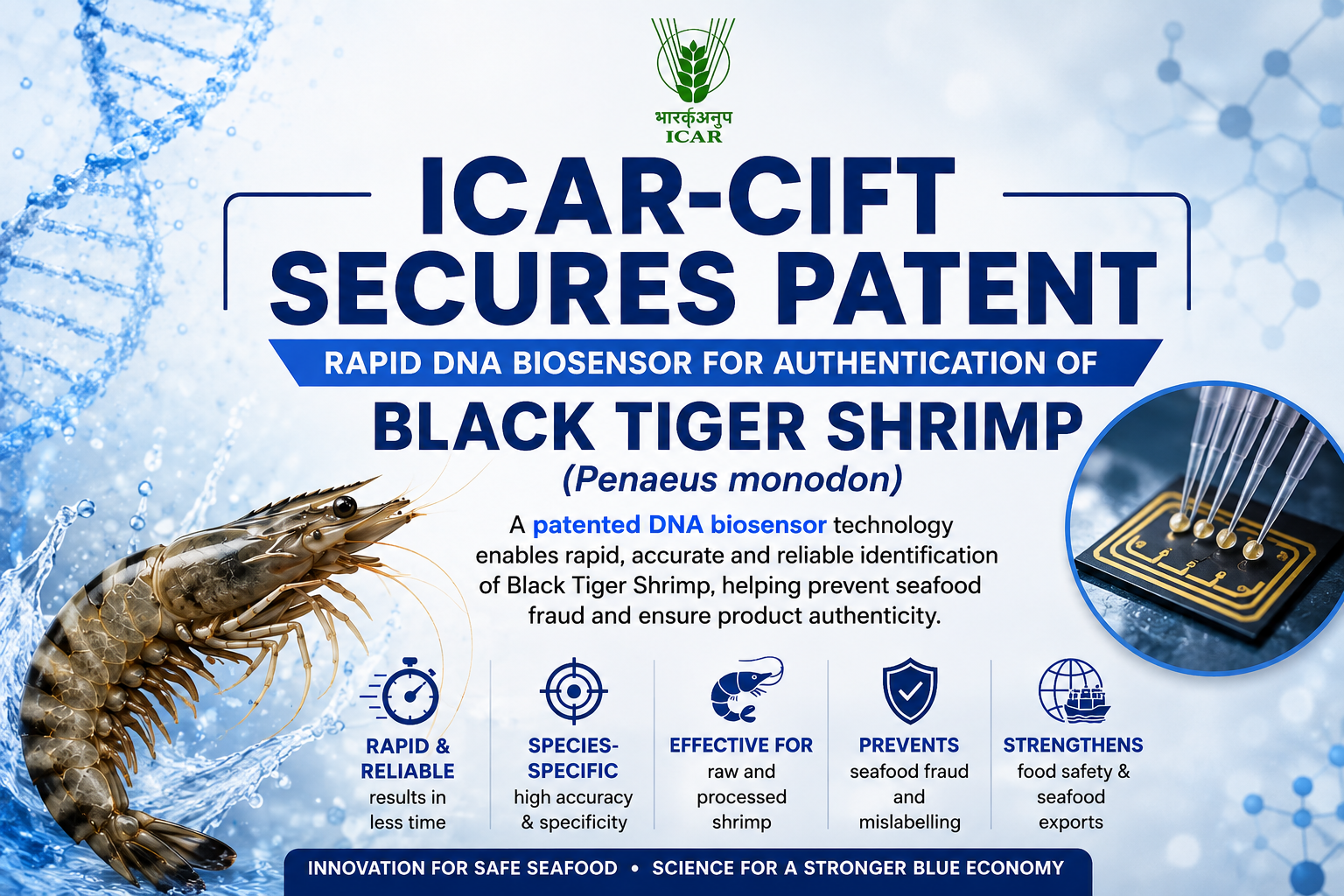
In a significant advancement for India’s seafood sector, the ICAR-Central Institute of Fisheries Technology (ICAR-CIFT) has secured a patent for a rapid DNA biosensor capable of accurately identifying Black Tiger Shrimp (Penaeus monodon). The innovation is expected to improve seafood authentication, strengthen quality assurance, and support India’s growing seafood export industry.
The patented biosensor has been developed to provide fast and species-specific identification of Black Tiger Shrimp in both raw and processed seafood products. By offering a reliable method for verifying shrimp species, the technology could help reduce product mislabelling and improve transparency throughout the seafood supply chain.
Why Is Species Authentication Important?
Black Tiger Shrimp is one of the world’s most valuable cultured shrimp species and is widely exported from India. Because of its premium market value, accurate species identification is important for processors, exporters, importers, regulators, and consumers.
During processing and packaging, distinguishing one shrimp species from another can become difficult, especially when products are peeled, frozen, or processed. This creates the possibility of accidental misidentification or intentional substitution, commonly referred to as seafood fraud.
Incorrect labelling can affect consumer confidence, create trade disputes, and lead to regulatory issues in international markets where seafood traceability standards continue to become more stringent.
How Does the DNA Biosensor Help?
Unlike conventional identification methods that often require lengthy laboratory procedures, the newly patented biosensor uses species-specific DNA detection to rapidly confirm whether a sample is genuinely Black Tiger Shrimp.
According to ICAR-CIFT, the technology offers several advantages:
- Rapid and reliable identification in less time.
- High species specificity and accuracy.
- Suitable for both raw and processed shrimp.
- Helps prevent seafood fraud and product mislabelling.
- Supports food safety, quality assurance, and export compliance.
Faster identification means seafood businesses can verify product authenticity more efficiently before products enter domestic or international markets.
Supporting India’s Seafood Export Industry
India is among the world’s leading shrimp-exporting nations, with seafood shipments reaching major markets such as the United States, the European Union, Japan, China, and Southeast Asia. These markets increasingly demand stronger traceability systems and stricter quality verification throughout the supply chain.
Innovations such as DNA biosensors can help exporters demonstrate that the species declared on product labels matches the actual product being shipped. This strengthens buyer confidence, supports regulatory compliance, and enhances the credibility of Indian seafood in competitive global markets.
As international buyers continue to emphasise product authenticity, scientific tools like DNA-based authentication are becoming an important part of modern seafood quality management.
A Boost for Food Safety and Consumer Confidence
Beyond exports, the technology also has the potential to benefit domestic seafood markets. Consumers are becoming more aware of food quality, authenticity, and labelling, particularly for premium seafood products.
Rapid species verification can help processors, retailers, certification agencies, and food testing laboratories ensure that products sold as Black Tiger Shrimp are accurately labelled. This improves transparency throughout the supply chain while reducing the risk of fraudulent substitution.
The biosensor could also support regulatory agencies in routine seafood inspections, helping strengthen food safety monitoring and quality control programmes.
Developed by ICAR-CIFT Scientists
The patented technology was developed by scientists from ICAR-Central Institute of Fisheries Technology (ICAR-CIFT).
The inventors are:
- Dr. Lidiya Wilwet
- Dr. Toms C. Joseph
- Dr. P. Muhamed Ashraf
The innovation reflects ICAR-CIFT’s continued focus on developing scientific solutions that improve seafood quality, strengthen traceability, and support the sustainable growth of India’s fisheries and aquaculture sector.
Looking Ahead
As seafood supply chains become increasingly global, the ability to verify species quickly and accurately is becoming more important than ever. Technologies such as rapid DNA biosensors can help bridge the gap between scientific research and commercial seafood production by providing reliable tools for authentication and quality assurance.
The patent secured by ICAR-CIFT represents another step towards modernising India’s seafood sector. If adopted widely by testing laboratories, processors, and exporters, the technology could contribute to stronger consumer trust, reduced seafood fraud, and improved competitiveness for Indian seafood in international markets.
