
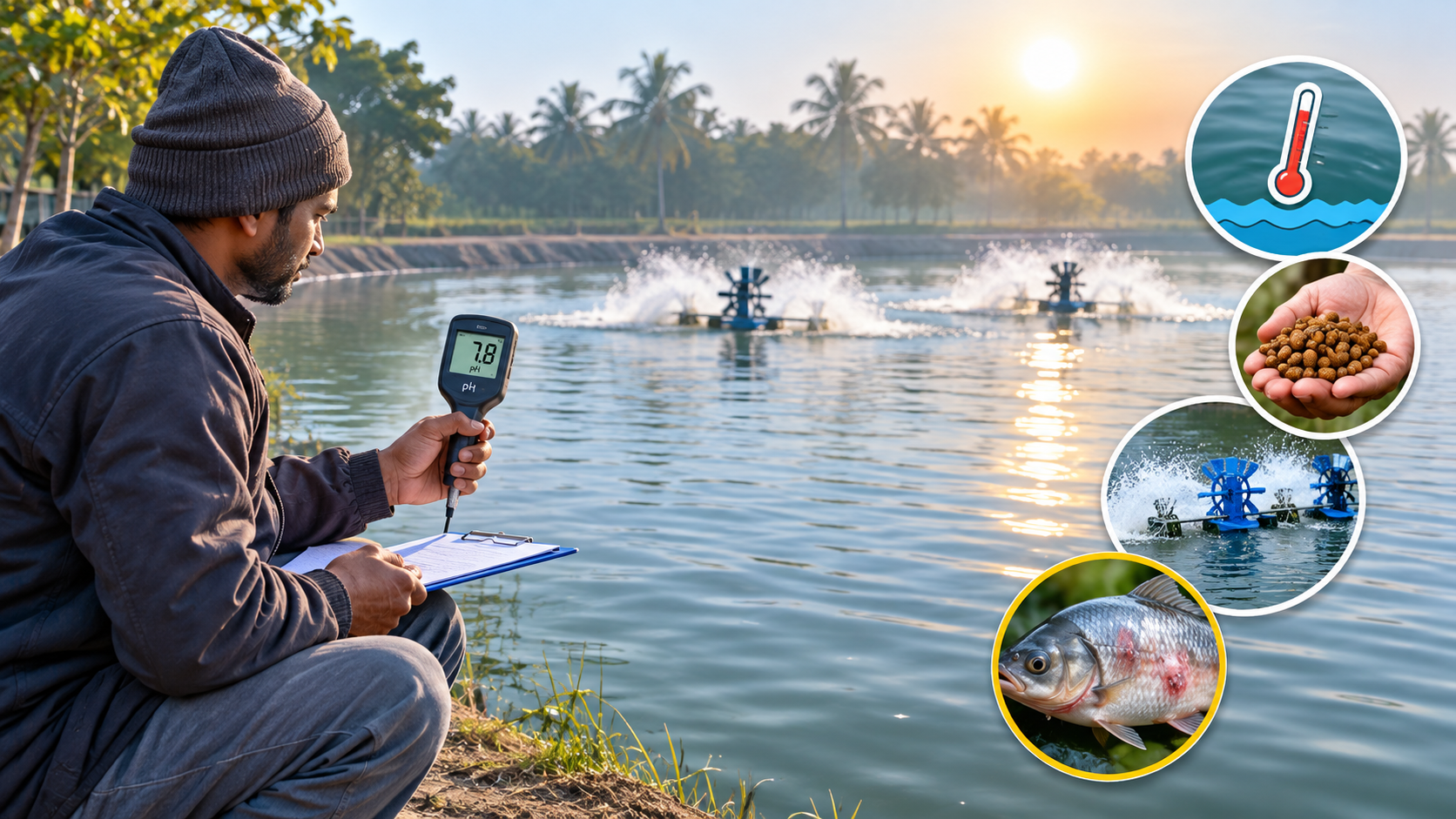
Winter can create additional challenges for fish farmers. Falling water temperatures can affect fish activity, feeding behaviour, growth and immunity. Without proper pond management, fish may become more vulnerable to diseases.
Maintaining suitable water conditions and adjusting daily farm practices are therefore important during the colder months.
Here are some important precautions farmers should follow during winter.
1. Maintain Adequate Pond Water Depth
Maintain a water depth of around 6 feet in the pond, as recommended in the reported advisory. Adequate water depth helps reduce sudden temperature fluctuations and provides a more stable envgeneironment for fish.
Avoid unnecessary water exchange during colder periods, particularly when incoming water is significantly colder than the pond water.
2. Monitor Water Temperature
When water temperatures fall below 15°C, fish activity and feed consumption can decline, depending on the species.
Farmers should monitor pond temperature regularly. If using borewell water, introduce it carefully after checking its temperature and suitability. Sudden temperature changes can stress fish.
3. Increase Aeration at High Stocking Densities
High stocking density increases oxygen demand, particularly when fish are stressed by changing environmental conditions.
Farmers should ensure that aerators are functioning properly and adjust aeration according to pond conditions and dissolved oxygen levels.
Water circulation using suitable pumping equipment can also help improve oxygen distribution. However, it should not replace adequate aeration.
4. Adjust Feeding According to Fish Activity
Fish generally become less active as water temperature decreases. Their metabolism and feed consumption may also decline.
Farmers should:
- Reduce feed quantities when fish consumption decreases.
- Observe feeding trays or feeding response before increasing feed.
- Avoid leaving uneaten feed in the pond.
- Adjust feeding according to species, fish size and water temperature.
Continuing the same feeding schedule without considering temperature changes can increase feed waste and organic matter accumulation.
5. Maintain Suitable Water pH
Monitor pond pH regularly, particularly when weather conditions change.
The advisory recommends maintaining pH between 7.5 and 8.5. Farmers should also monitor dissolved oxygen, ammonia and other important water quality parameters rather than relying on pH alone.
Avoid making sudden corrections to pH without checking the actual water condition.
6. Watch for Fungal and Bacterial Diseases
During winter, farmers should regularly inspect fish for unusual symptoms.
Important warning signs include:
- White or cotton-like growth on the skin, which may indicate fungal infection.
- Red patches, ulcers or damaged skin.
- Fin and tail erosion.
- Damaged or discoloured gills.
- Reduced feeding and abnormal swimming.
Fungal, bacterial and parasitic infections can affect fish health. Early identification is important to prevent further losses.
7. Follow Proper Disease Management Practices
Do not apply lime, salt, potassium permanganate or other chemicals blindly.
The appropriate treatment depends on the fish species, disease diagnosis, pond condition and water quality. Farmers should consult a fisheries health professional before selecting a treatment and calculating its dosage.
Regular pond observation, proper stocking density, good water quality and timely disease diagnosis are essential for reducing winter-related fish health problems.
Protect Fish Health During Winter
Winter management is not just about maintaining pond temperature. Feeding, aeration, water quality and disease monitoring must all be managed together.
Farmers who regularly observe fish behaviour and respond to changing pond conditions can reduce avoidable stress and improve the chances of a healthy crop.
