
Introduction
Biofloc fish farming has rapidly emerged as one of the most promising technologies in modern aquaculture. By allowing farmers to produce more fish in a limited space while using significantly less water, the technology has attracted the attention of both small-scale farmers and commercial aquaculture entrepreneurs.
However, despite its growing popularity, Biofloc is often misunderstood. While many farmers have achieved good production and profitability using this system, others may experience significant losses if they adopt it without fully understanding how it works. In most cases, the problem is not the technology itself but inadequate planning, poor management, and a lack of technical knowledge.
Before investing in a Biofloc system, it is important to understand how the technology works, the infrastructure it requires, and the daily management practices needed for successful fish farming. This guide explains every major aspect of Biofloc fish farming—from its basic principles to practical management—helping beginners make informed decisions before getting started.
What is Biofloc Fish Farming?
Biofloc fish farming is an intensive aquaculture system that uses beneficial microorganisms to maintain water quality and recycle nutrients within the culture tank. Instead of relying on frequent water exchange, the system converts organic waste into microbial biomass, creating a healthier environment for fish while improving resource efficiency.
One of the most common misconceptions among beginners is assuming that Biofloc and Biofloc Technology mean the same thing. Although closely related, they are different.
Biofloc Technology (BFT) is the complete farming system. It includes tank design, aeration, water quality management, carbon source management, feeding practices, stocking density, and other management techniques that work together to maintain a stable culture environment.
Biofloc, on the other hand, refers to the tiny aggregates of beneficial bacteria, algae, protozoa, organic particles, and other microorganisms suspended in the water. These microbial flocs recycle waste nutrients and also serve as a supplementary natural food source for cultured fish.
Simply installing tanks and aeration equipment does not create a Biofloc system. The success of the technology depends on establishing and maintaining a healthy microbial ecosystem inside the culture water.
How Does Biofloc Technology Work?
In conventional fish farming, uneaten feed and fish waste gradually accumulate in ponds or tanks. As this organic matter decomposes, it releases ammonia and other nitrogenous compounds that can become toxic to fish if they are allowed to build up.
Biofloc Technology manages this waste through naturally occurring beneficial bacteria. When an appropriate carbon source is available, these microorganisms utilize ammonia and other nitrogen compounds for their growth, converting dissolved waste into microbial biomass known as Bioflocs.
Continuous aeration keeps these Bioflocs suspended throughout the water column while maintaining adequate dissolved oxygen levels. Many cultured fish species naturally consume these microbial flocs, allowing them to obtain additional nutrients alongside their regular commercial feed. As a result, waste generated within the culture system is recycled into a useful biological resource instead of becoming a pollutant.
The efficiency of this biological process depends on maintaining the right balance between feeding, aeration, microbial activity, and water quality. If this balance is disturbed, the entire system can become unstable.
Why Are Farmers Adopting Biofloc Technology?
Biofloc Technology offers several practical advantages that have contributed to its increasing adoption across India’s aquaculture sector.
One of its biggest advantages is the ability to produce more fish in a relatively small area. Because water quality is maintained biologically, farmers can culture fish at higher stocking densities than many conventional systems, making better use of available land.
Another major benefit is reduced water consumption. Unlike traditional pond farming, which often requires regular water exchange, Biofloc systems operate with minimal or even zero water exchange under proper management. This makes the technology particularly useful in regions where freshwater availability is limited.
Bioflocs also provide supplementary natural nutrition. The microbial aggregates formed within the system contain protein and other nutrients that can be consumed by fish. However, Biofloc is not a replacement for commercial feed. A balanced formulated feed remains the primary source of nutrition, while Bioflocs serve as an additional food resource that may improve feed utilization.
In addition, Biofloc promotes a more sustainable approach to aquaculture by recycling nutrients within the culture system and reducing waste discharge into the surrounding environment.
Benefits and Challenges of Biofloc Fish Farming
Like any aquaculture technology, Biofloc offers both opportunities and challenges. Understanding both is essential before deciding to adopt the system.
Benefits
Biofloc Technology offers several advantages for fish farmers, including:
- Higher production from limited land.
- Reduced water exchange requirements.
- Better nutrient recycling within the culture system.
- Supplementary natural nutrition through microbial flocs.
- Improved resource efficiency and environmental sustainability.
- Potential for better feed utilization under proper management.
Challenges
Despite its advantages, Biofloc is not a low-maintenance farming system.
Continuous aeration is essential to keep Bioflocs suspended and maintain adequate dissolved oxygen levels. Any prolonged interruption in aeration can affect both fish and beneficial microorganisms. Regular monitoring of water quality, disciplined feeding practices, and consistent system management are equally important.
Many production failures occur not because Biofloc Technology is ineffective, but because the system is started without sufficient technical knowledge or managed without regular monitoring. Overfeeding, poor water quality management, inadequate aeration, and the absence of a reliable power backup are among the most common reasons for failure.
For this reason, Biofloc should be viewed as a scientifically managed biological system rather than simply another method of fish farming.
Tank Design and Infrastructure
The design of a Biofloc tank plays a critical role in maintaining water quality and ensuring the smooth functioning of the system. Unlike conventional ponds, where natural processes help manage waste, Biofloc systems depend on controlled conditions that support continuous microbial activity. A poorly designed tank can make water circulation, waste removal, and aeration less effective, increasing the risk of management problems.
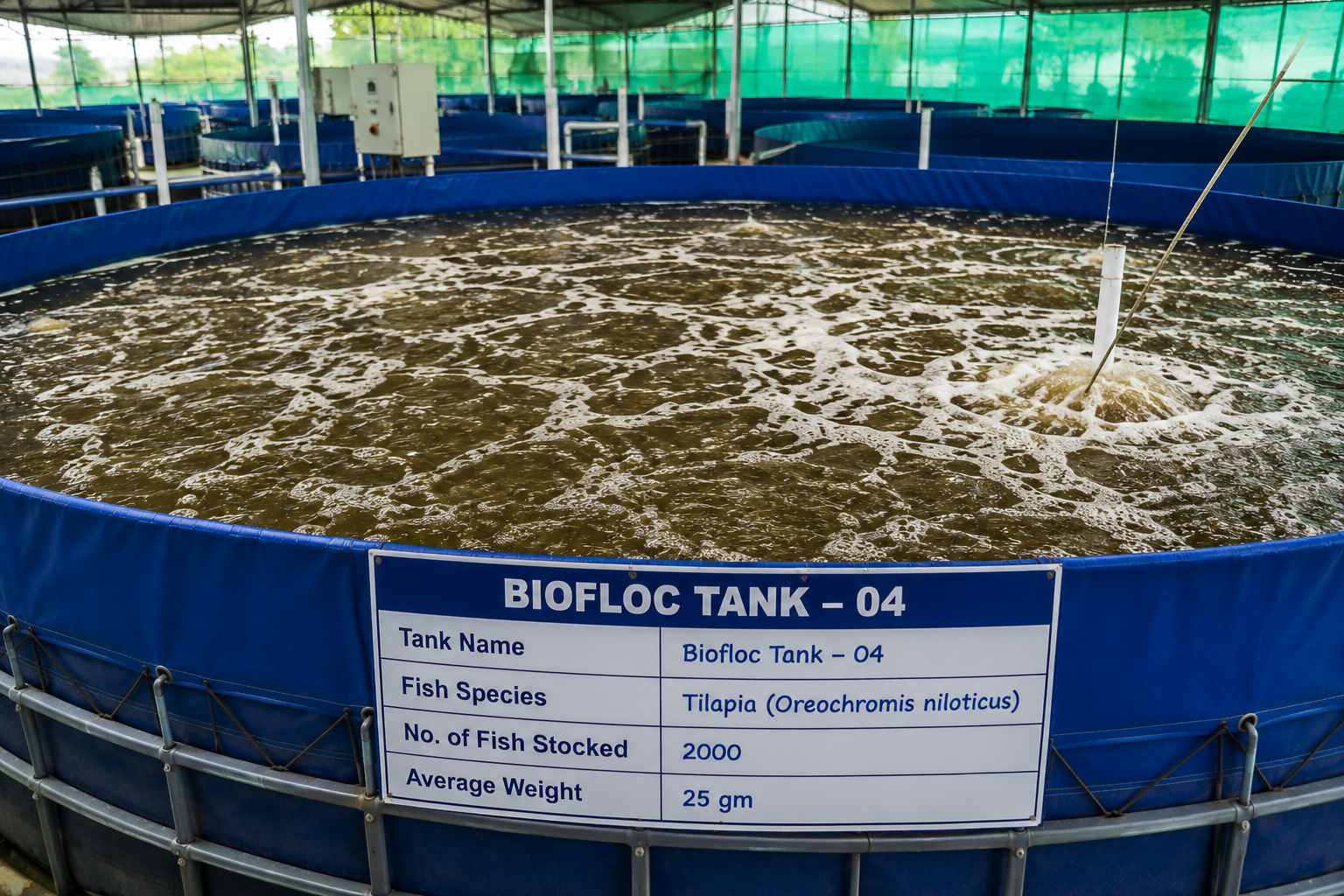
Circular tanks are the most commonly used option because they allow water to circulate uniformly, preventing the accumulation of waste in one area. The tank floor is generally constructed with a gentle slope towards the centre, where a central drain is installed. This design helps remove settled solids whenever required without disturbing the entire culture system. Overflow arrangements are also provided to regulate water levels during heavy rainfall or accidental overfilling.
Biofloc tanks are commonly built using tarpaulin, HDPE liners, fibre-reinforced plastic (FRP), or other durable materials supported by a strong frame. Regardless of the material used, the structure should be leak-proof, easy to clean, and capable of withstanding continuous aeration and regular operation.
Before stocking fish, the tank is filled with water and aerated continuously for at least 24 hours. This conditioning period helps stabilize the water and prepares the system for the development of beneficial microorganisms.
Another essential requirement is uninterrupted aeration. Since Biofloc Technology relies on beneficial bacteria that require oxygen to remain active, air blowers, diffusers, or air stones must operate continuously. Maintaining dissolved oxygen at appropriate levels supports both microbial activity and fish health. A reliable power backup is equally important because even short interruptions in aeration can affect the biological balance of the system.
Preparing the Biofloc System
Setting up a tank is only the first step. Before fish can be stocked, the Biofloc system itself must be established by developing a healthy population of beneficial microorganisms.
This process begins with the preparation of a starter culture, also known as an inoculum. The purpose of the starter culture is to introduce and multiply beneficial bacteria that initiate the formation of Bioflocs inside the tank. Without these microorganisms, the system cannot effectively recycle waste nutrients.
Once the starter culture is added, the bacteria begin utilizing organic matter and nitrogenous waste in the presence of an appropriate carbon source. Over time, these microorganisms multiply and combine with suspended organic particles, forming the Bioflocs that characterize the system.
It is important to remember that Biofloc does not develop overnight. The microbial community requires time to establish itself before fish are stocked. Stocking fish too early, before the biological system has matured, may result in unstable water quality and increased stress on the cultured species.
For this reason, farmers should confirm that the Biofloc system has become biologically active before introducing fish seed.
Monitoring Biofloc Using an Imhoff Cone
Once Bioflocs begin developing, regular monitoring becomes an essential part of daily management. While several water quality parameters require routine testing, farmers also need to monitor the quantity of Biofloc present in the culture water.
The most commonly used tool for this purpose is the Imhoff Cone.
An Imhoff Cone is a transparent, cone-shaped measuring device used to estimate the volume of settleable Bioflocs present in the water. A water sample collected from the tank is poured into the cone and allowed to settle for a specified period. The settled Biofloc is then measured directly using the graduated markings on the cone.
Regular monitoring helps farmers determine whether the amount of Biofloc in the system is within the desired range. If the floc volume is too low, the microbial population may not be sufficiently developed. On the other hand, excessive Biofloc accumulation can increase suspended solids and affect water quality if not managed properly.
Rather than relying on visual observations alone, the Imhoff Cone provides a simple and practical method for tracking Biofloc development and supporting better management decisions.
Which Fish Species Are Suitable for Biofloc Farming?
Not every fish species performs equally well in a Biofloc system. Since the technology involves high stocking densities and elevated concentrations of suspended microbial flocs, suitable species should be capable of tolerating these conditions while efficiently utilizing the available natural food.
In general, species selected for Biofloc farming should have a good growth rate, adapt well to intensive culture, tolerate fluctuations in water quality, and be able to utilize Bioflocs as a supplementary food source. Consumer demand and market value are also important considerations when choosing a species.
Several freshwater fish species have demonstrated good performance under Biofloc culture. Among them, Tilapia is widely regarded as one of the most suitable species because of its ability to utilize Bioflocs efficiently and adapt to intensive farming conditions.
Other commonly cultured species include Pangasius, Common Carp, Rohu, Magur, Singhi, Koi (Anabas), Pabda, and Milkfish, depending on regional farming practices and market demand. In addition to fish, Biofloc Technology has also been successfully adopted for shrimp species such as Pacific White Shrimp (Litopenaeus vannamei) and Black Tiger Shrimp (Penaeus monodon) under appropriate culture conditions.
The choice of species should always be based on the farmer’s experience, infrastructure, local climate, seed availability, and market opportunities rather than simply selecting the most popular option.
Stocking Fish in a Biofloc System
Stocking is one of the most important stages in Biofloc fish farming. Even if the tank is well designed and the Biofloc system has been established successfully, poor stocking practices can affect fish health and overall production.
Fish should be stocked only after the Biofloc system has matured and beneficial microorganisms have developed in the culture water. Introducing fish too early may expose them to unstable water conditions, increasing stress and reducing survival.
Before stocking, farmers should ensure that the fingerlings are healthy, active, and free from visible signs of disease. Selecting uniform-sized seed helps reduce competition for feed and minimizes the risk of cannibalism in species where it may occur. Proper acclimatization is equally important to reduce stress caused by sudden changes in water temperature and other environmental conditions.
Stocking density should never be decided solely based on tank size. It should also consider the cultured species, tank volume, aeration capacity, water quality management, and the farmer’s experience. Higher stocking densities can increase production but also demand more efficient management and continuous monitoring.
Feeding Management
Although Biofloc provides an additional natural food source, it does not eliminate the need for commercial feed. A nutritionally balanced formulated feed remains the primary source of nutrition, while Bioflocs serve as supplementary feed that can improve nutrient utilization.
Feeding should be based on the size, age, and biomass of the fish. Providing more feed than required can result in excess organic waste, increasing the biological load on the system and affecting water quality. On the other hand, underfeeding can slow growth and reduce productivity.
Regular observation of fish feeding behaviour is essential. Reduced appetite often indicates changes in water quality or the onset of health problems. Farmers should therefore adjust feeding according to the condition of the fish rather than following a fixed routine throughout the production cycle.
Since Biofloc systems continuously recycle nutrients, maintaining the right balance between feed input and microbial activity is one of the most important aspects of successful management.
Water Quality Management
Water quality is the foundation of every successful Biofloc system. Unlike conventional pond farming, where water exchange can help correct problems, Biofloc relies on maintaining a stable biological environment. Even small changes in water quality can influence both fish health and microbial activity.
Among all water quality parameters, dissolved oxygen is one of the most critical because both fish and beneficial bacteria depend on adequate oxygen levels. Continuous aeration is therefore essential throughout the culture period.
Other important parameters include pH, temperature, ammonia, alkalinity, and Biofloc volume. These should be monitored regularly to ensure that the system remains biologically stable. Significant fluctuations in any of these parameters can affect fish growth, microbial performance, and overall production.
The Imhoff Cone is commonly used to monitor Biofloc volume, while standard water quality testing kits help assess chemical parameters. Together, these tools enable farmers to detect problems early and take corrective action before they affect the culture system.
One of the key principles of Biofloc farming is that fish health and water quality are closely interconnected. Healthy microbial activity supports better water quality, while stable water conditions help fish remain healthy and grow efficiently. For this reason, routine monitoring should become a daily management practice rather than an occasional activity.
Common Mistakes Beginners Should Avoid
Biofloc Technology offers several advantages, but it also requires careful management. Many production failures occur because of avoidable mistakes during planning or daily operation.
One of the most common mistakes is starting a Biofloc system without understanding how it works. Installing tanks and aeration equipment alone does not guarantee success. Farmers should first gain practical knowledge of water quality management, microbial activity, feeding, and routine monitoring before investing in the technology.
Overfeeding is another frequent problem. Excess feed increases organic waste, disturbs the biological balance of the system, and can lead to deterioration in water quality.
Many beginners also neglect regular monitoring of water quality and Biofloc volume. Without routine testing, problems such as low dissolved oxygen, ammonia accumulation, or excessive suspended solids may remain unnoticed until fish begin showing signs of stress.
Another critical mistake is operating the system without a reliable power backup. Since aeration must run continuously, power failures can quickly reduce dissolved oxygen levels and affect both fish and beneficial microorganisms.
Finally, some farmers respond to every problem by adding chemicals or medicines without identifying the actual cause. In many situations, improving aeration, adjusting feeding, or correcting water quality provides a more effective solution than unnecessary chemical treatments.
Before You Start Biofloc Fish Farming
Before setting up a Biofloc unit, farmers should honestly assess whether they are prepared for the daily responsibilities that come with this technology.
A continuous electricity supply with a dependable backup system is essential because uninterrupted aeration is the backbone of Biofloc farming. Farmers should also be willing to monitor the system every day, as Biofloc cannot be left unattended for long periods.
Equally important is acquiring basic knowledge of water quality management, feeding practices, and Biofloc biology. Investing time in training before investing money in infrastructure can significantly improve the chances of success.
Biofloc is not a shortcut to higher profits. Like any intensive aquaculture system, its performance depends on careful planning, scientific management, and timely decision-making.
Conclusion
Biofloc Technology has transformed the way fish can be cultured by converting waste into a valuable biological resource while reducing water use and supporting intensive production. However, the technology demands much more than tanks and aeration. Success depends on understanding the biological processes within the system, maintaining stable water quality, following disciplined feeding practices, and monitoring the culture environment consistently.
For farmers willing to adopt scientific management and invest time in learning the system, Biofloc offers a sustainable and efficient approach to modern aquaculture. With proper planning, regular monitoring, and good management practices, it can become a productive option for fish farming in areas where land and water resources are limited.
Source
- National Fisheries Development Board (NFDB), Recent Trends in Aquaculture: Biofloc Fish Culture.
- ICAR–Central Marine Fisheries Research Institute (CMFRI), Training Manual on Biofloc Culture.
