
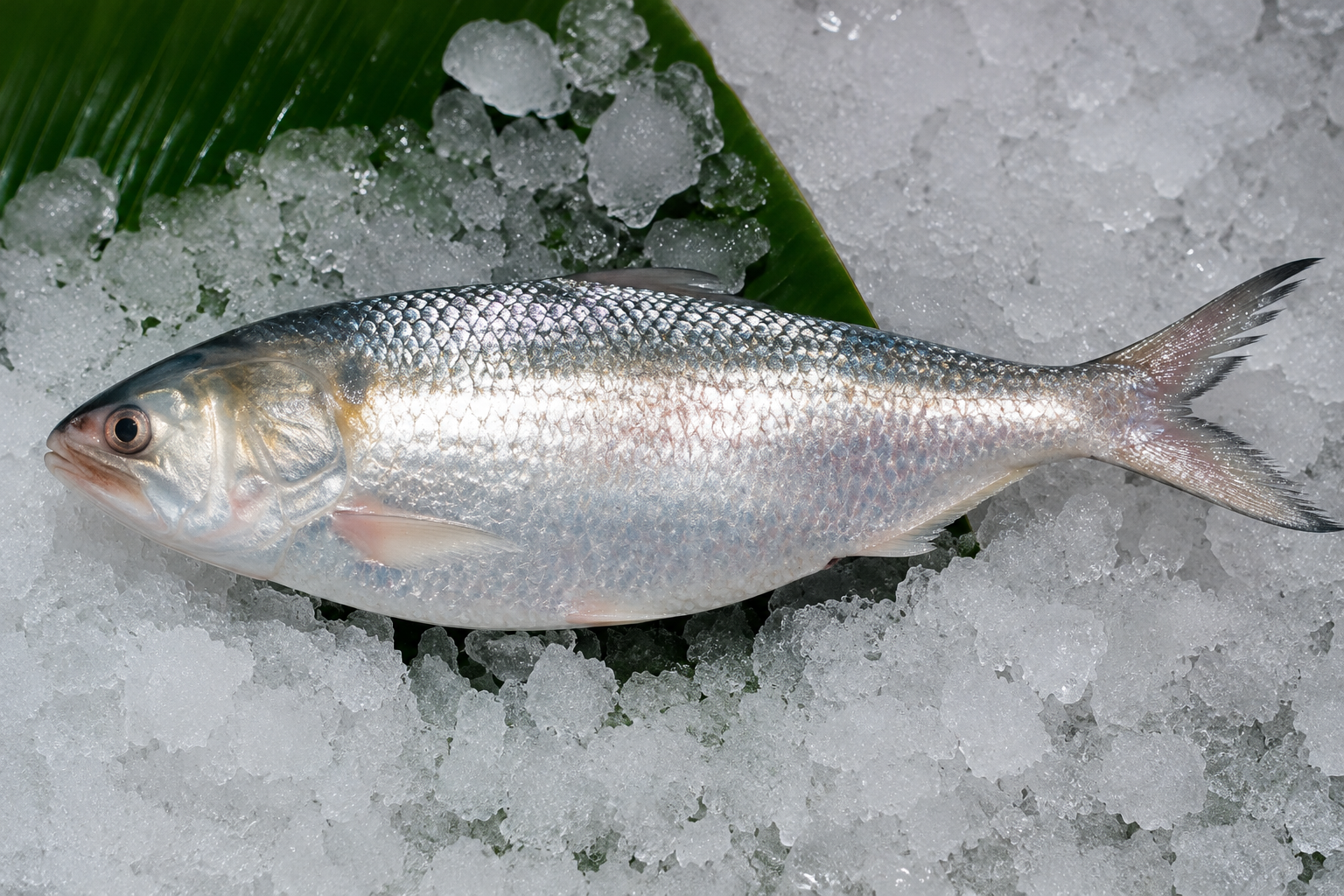
Hilsa (Tenualosa ilisha) has been recorded in the middle and upper stretches of the Ganga after remaining virtually absent from these reaches for decades, marking a significant development in river restoration and aquatic biodiversity conservation.
According to the ICAR-Central Inland Fisheries Research Institute (ICAR-CIFRI), two hilsa weighing a combined 740 grams were found in the river near the Markandey Mahadev Temple in Chandauli district of Uttar Pradesh. The finding comes nearly three decades after the species had disappeared from the upstream reaches.
Hilsa Returns to Its Historical Range
Historically, hilsa migrated from the Bay of Bengal through the Ganga system towards Varanasi, Prayagraj and beyond. However, the commissioning of the Farakka Barrage in 1975 significantly disrupted its migratory pathway, contributing to a sharp decline in hilsa in the middle and upper Ganga.
The decline affected both the species and riverine fishing communities that depended on hilsa and other aquatic resources.
Recognising the ecological, nutritional, cultural and livelihood importance of hilsa, ICAR-CIFRI, Barrackpore, along with the National Mission for Clean Ganga (NMCG), initiated a long-term scientific programme focused on restoring the species in the Ganga.
Nearly 4 Lakh Hilsa Released
Between 2019 and June 2026, the restoration programme used an integrated approach that included river ranching, stock enhancement, artificial breeding, release of fertilised eggs and hatchery-produced spawn.
The programme also involved tagging, post-release monitoring and stakeholder participation to track the movement and survival of released fish.
According to ICAR-CIFRI, more than 3.85 lakh juvenile and adult hilsa were ranched during the programme. In addition, more than 40 lakh fertilised eggs and approximately 9.41 lakh hatchery-produced spawn, aged between two and six days, were released upstream of the Farakka Barrage.
Tagging and systematic monitoring helped researchers collect information on the migration, survival and movement of the released hilsa.
Hilsa Movement Shows Signs of Recovery
Monitoring conducted between 2023 and 2025 had earlier recorded the upstream movement of ranched hilsa up to Mirzapur. The latest detection in Chandauli indicates further movement into the species’ historical range.
For a sensitive migratory species such as hilsa, its presence in upstream stretches can provide valuable information about river connectivity and habitat suitability.
The return of hilsa therefore offers an encouraging ecological signal and indicates that long-term restoration interventions may be helping the species regain parts of its historical distribution.
Why Hilsa Matters to River Ecosystems
Hilsa is a migratory fish whose life cycle depends on suitable river habitats and connectivity. Its movement through the river system makes it an important species for understanding changes in aquatic ecosystems.
The detection of hilsa in the upper stretches of the Ganga can provide researchers with useful information about the condition and connectivity of the river.
The restoration programme also demonstrates how fisheries science, river conservation, hatchery technology, monitoring and stakeholder participation can work together to support the recovery of a native migratory species.
A Long-Term Approach to Fisheries Conservation
The hilsa restoration programme highlights the importance of sustained conservation efforts rather than relying only on short-term stocking.
Artificial breeding and stock enhancement can increase the availability of fish for release, but monitoring their movement and survival is equally important. Tagging and post-release observations have helped researchers understand how the fish move through the river after being released.
The collaboration between ICAR-CIFRI and NMCG combines fisheries research with river conservation, while stakeholder participation adds an important community dimension to the restoration programme.
What the Return of Hilsa Means for the Ganga
The detection of hilsa in the middle and upper Ganga represents an encouraging development for fisheries conservation and river restoration.
It also offers hope for restoring other native and migratory aquatic species whose historical ranges have been affected by changes in river connectivity and habitat conditions.
The return of hilsa reinforces the importance of managing rivers as living ecosystems, where aquatic biodiversity, fish migration, habitats and fishing communities are closely connected.
For the Ganga, the latest hilsa sightings provide a positive indication of what sustained scientific research, restoration efforts and coordinated conservation programmes can achieve over time.
