
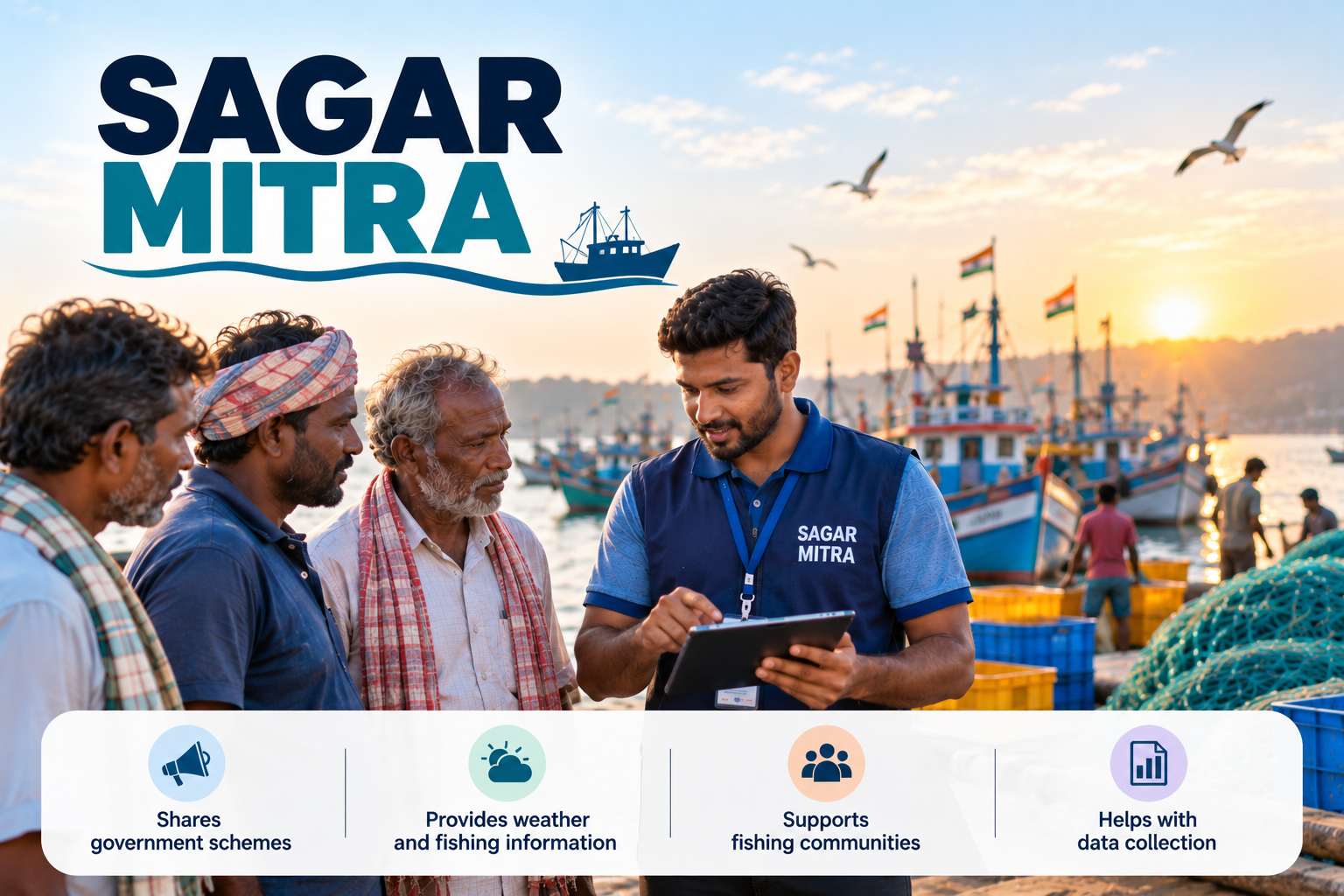
India’s fisheries sector depends not only on fishers and government departments but also on an effective connection between the two. Government schemes, weather advisories, fishing information, conservation measures, welfare programmes and technical guidance are useful only when they reach the people who need them.
This is where the role of Sagar Mitra becomes important.
Sagar Mitras were introduced as grassroots-level fisheries support personnel for coastal fishing communities. Their role is to act as a local point of contact between marine fishers and the fisheries administration, while also supporting awareness, information dissemination, fisheries data collection and sustainable fisheries management.
The position is part of the wider effort to strengthen extension services in India’s marine fisheries sector under the Pradhan Mantri Matsya Sampada Yojana (PMMSY).
What Is a Sagar Mitra?
A Sagar Mitra is a fisheries support worker engaged in coastal fishing villages to provide multiple services to marine fishers.
In simple terms, the Sagar Mitra is intended to serve as a local bridge between the Fisheries Department and the fishing community.
Marine fishers often require timely information on government schemes, weather conditions, Potential Fishing Zones, fishing regulations, safety, conservation and other fisheries-related matters. At the same time, the government requires reliable information from the field about fish production, fishing activity and local fisheries conditions.
The Sagar Mitra system was created to help strengthen this two-way flow of information.
When Was the Sagar Mitra Position Introduced?
The Sagar Mitra programme was introduced under the Pradhan Mantri Matsya Sampada Yojana (PMMSY).
PMMSY was approved by the Union Cabinet on 20 May 2020 and was formally launched on 10 September 2020. The scheme included Sagar Mitras as part of its fisheries extension and support system.
Under the original PMMSY framework, the government proposed the engagement of thousands of Sagar Mitras across coastal fishing villages. A PIB announcement in May 2020 referred to the plan to register 3,477 Sagar Mitras in coastal fisher villages
The programme was therefore not created as a regular departmental post in the traditional sense. Instead, Sagar Mitras were engaged under a specific fisheries development programme to strengthen services at the village level.
When Did Recruitment Begin?
Following the launch and implementation of PMMSY, coastal States and Union Territories began recruiting Sagar Mitras.
In Andhra Pradesh, district-level notifications for Sagara Mitra recruitment were issued during late 2020 and early 2021.
For example:
- Krishna district issued a notification beginning on 26 December 2020.
- East Godavari initiated the selection process in December 2020.
- Prakasam, Guntur, West Godavari and Srikakulam also issued recruitment notifications in January 2021.
This means that while the Sagar Mitra programme was conceived under PMMSY in 2020, the actual recruitment and deployment process in Andhra Pradesh largely began around 2020–21.
What Was the Main Purpose of Creating Sagar Mitras?
The marine fisheries sector operates across a vast coastal area and involves thousands of fishing families and villages. Ensuring that every fisher receives timely information and support is a major challenge.
The Sagar Mitra programme was designed to strengthen last-mile fisheries extension services.
The purpose was not simply to create another administrative position. The larger objective was to establish a local-level support system that could:
- connect fishers with fisheries-related services;
- create awareness about government schemes and programmes;
- share important information with fishing communities;
- support sustainable fisheries management;
- collect fisheries-related information and data from the field; and
- improve communication between coastal communities and the Fisheries Department.
PMMSY specifically envisaged Sagar Mitras as multipurpose workers deployed in coastal villages to provide support services to marine fishers and assist with activities such as fish catch documentation.
What Does a Sagar Mitra Do?
The responsibilities of a Sagar Mitra extend across several areas of marine fisheries.
1. Acting as a Point of Contact for Fishers
One of the key responsibilities is to serve as a first point of contact for marine fishers regarding fisheries-related services and requirements.
This helps create a local communication channel between fishing communities and the Fisheries Department.
2. Creating Awareness About Government Schemes
The fisheries sector has several government programmes related to livelihoods, infrastructure, welfare, safety and fisheries development.
A Sagar Mitra helps create awareness among local fishers about these schemes and programmes so that information can reach communities at the grassroots level. (Cofm)
3. Sharing Weather and Fishing Information
For marine fishers, timely information can be extremely important.
The role includes disseminating information related to:
- weather forecasts;
- Potential Fishing Zones (PFZ);
- natural calamities and related advisories.
Such information can help fishers make more informed decisions before and during fishing activities.
4. Supporting Fisheries Data Collection
Reliable fisheries data is essential for planning and managing the sector.
Sagar Mitras may assist in compiling information related to:
- daily fish production;
- fishing vessels;
- vessel movement;
- fish prices; and
- marketing information.
This information can support fisheries administration and improve understanding of activities at the local level.
5. Promoting Sustainable Fishing Practices
Marine resources are limited, and long-term fisheries development depends on responsible utilisation.
The Sagar Mitra role includes creating awareness about sustainable use of fisheries resources, relevant regulations, conservation of coastal and ocean ecosystems and the prevention of illegal, unreported and unregulated fishing.
6. Creating Awareness About Hygiene and Fish Handling
The work also extends to awareness about hygienic fish handling, personal hygiene and improved working and living conditions.
These aspects are important because fisheries development is not limited to catching fish. The quality and handling of fish after harvest also influence the value received by fishers and the wider seafood supply chain.
7. Supporting Alternative Livelihoods and Women’s Participation
Sagar Mitras may also help promote alternative livelihood opportunities, particularly in areas such as post-harvest activities and marketing.
The role also includes mobilising members of fishing communities for training and capacity-building programmes, including initiatives that can support women’s participation in fisheries-related livelihoods.
Who Can Become a Sagar Mitra?
The eligibility framework has evolved since the programme was introduced.
Initially, PMMSY envisaged fisheries professionals with qualifications such as a Bachelor’s degree in Fisheries Science, Marine Biology or Zoology. However, the eligibility criteria were subsequently revised following requests from coastal States and Union Territories.
According to information presented in Parliament in December 2024, the qualification was revised to 12th pass in the Science stream, with preference given to candidates with higher qualifications, people from local fishing communities and women candidates. Communication skills in the local language and familiarity with information technology are also important for the nature of the work.
The intention behind preferring local candidates is easy to understand: a person familiar with the local fishing community, language and conditions may be better placed to communicate with fishers and understand their needs.
Is Sagar Mitra a Permanent Government Job?
This is an important point in understanding the position.
The Sagar Mitra engagement was created under PMMSY and is based on a contractual or programme-based arrangement rather than regular government employment.
The original PMMSY guidelines made clear that Sagar Mitras were engaged under the scheme and that the Department of Fisheries, Government of India was not responsible for their continuation after the scheme period. The guidelines also provided that States or Union Territories could decide on continuation based on their requirements.
Later operational revisions also described the engagement as part-time and linked to the scheme framework. The revised guidelines fixed a uniform honorarium of ₹15,000 per month, along with a mobile phone user allowance of up to ₹300 per month under the specified provisions.
Therefore, the status of a Sagar Mitra should be understood as a scheme-based contractual engagement, not as an automatically permanent government post.
How Important Is Sagar Mitra in Andhra Pradesh?
Andhra Pradesh has a long coastline and a large marine fisheries sector, making grassroots fisheries support particularly important.
The Government of India approved a proposal for the engagement of 350 Sagar Mitras in coastal villages of Andhra Pradesh under PMMSY, according to a Rajya Sabha reply dated August 2025.
For coastal fishing communities, a Sagar Mitra can play a role in connecting local-level realities with government programmes and fisheries administration.
Their work can involve interaction with fishers, awareness programmes, information sharing, data collection and support for the implementation of fisheries initiatives.
This makes the position part of the wider fisheries ecosystem rather than simply an individual job role.
Understanding the Sagar Mitra Ecosystem
The importance of Sagar Mitras becomes clearer when we look at the complete system.
Government and Fisheries Department
Government departments formulate fisheries policies, welfare schemes, conservation measures and development programmes.
Fisheries Officers and District Administration
These institutions coordinate implementation, monitoring and administration at the State and district levels.
Sagar Mitra
The Sagar Mitra functions at the grassroots level, helping connect the institutional system with coastal fishing communities.
Fishers and Fishing Communities
Fishers are the ultimate beneficiaries and participants in the fisheries ecosystem. Their experiences, needs and field-level information are essential for effective implementation of fisheries programmes.
The intended flow is therefore not only government to fisher. It is also fisher to government.
Information, concerns, fisheries data and local conditions can move upward, while schemes, advisories and awareness can move downward.
This two-way connection is one of the central ideas behind the Sagar Mitra model.
Why Does the Sagar Mitra Role Matter?
Fisheries is a sector where information can have a direct impact on livelihoods.
A weather advisory may influence whether a fishing trip is safe. Information about a government scheme may help a fisher access available support. Awareness about sustainable fishing can contribute to the long-term health of marine resources. Accurate catch and fisheries data can help authorities better understand the sector.
However, these systems are effective only when information reaches people at the ground level.
That is why a grassroots fisheries support role such as Sagar Mitra matters.
The position was created to strengthen the connection between fisheries institutions and coastal communities and to bring extension services closer to fishers. PMMSY itself identified well-structured extension support services as an important component of fisheries development.
The Future of Sagar Mitras
The future of Sagar Mitras is closely connected to government decisions, State-level implementation and the continuation or evolution of fisheries programmes.
PMMSY was originally approved for the period from FY 2020–21 to FY 2024–25 and was subsequently extended through FY 2025–26 under the existing scheme design and funding pattern.
Because Sagar Mitras are engaged within this scheme-based framework, questions regarding continuation, employment security and future engagement depend on decisions taken by the relevant governments and implementing authorities.
For the Sagar Mitras currently working at the grassroots level, this is particularly significant because their role supports an important part of the fisheries extension system while their engagement itself remains linked to programme and government decisions.
Conclusion
Sagar Mitra was created under PMMSY to strengthen India’s marine fisheries extension system at the grassroots level.
The role connects several important parts of the fisheries ecosystem: government programmes, fisheries administration, information services, data collection, sustainable fishing practices and coastal fishing communities.
In Andhra Pradesh, recruitment began during the 2020–21 period, with Sagar Mitras being engaged across coastal areas under PMMSY. Over the years, their responsibilities have made them an important local link between fishers and the fisheries administration.
The larger question surrounding Sagar Mitras today is not only about what work they perform. It is also about the future of a grassroots workforce created to support one of India’s most important livelihood sectors.
Their role explains why they matter. Their future now depends on what comes next.
