
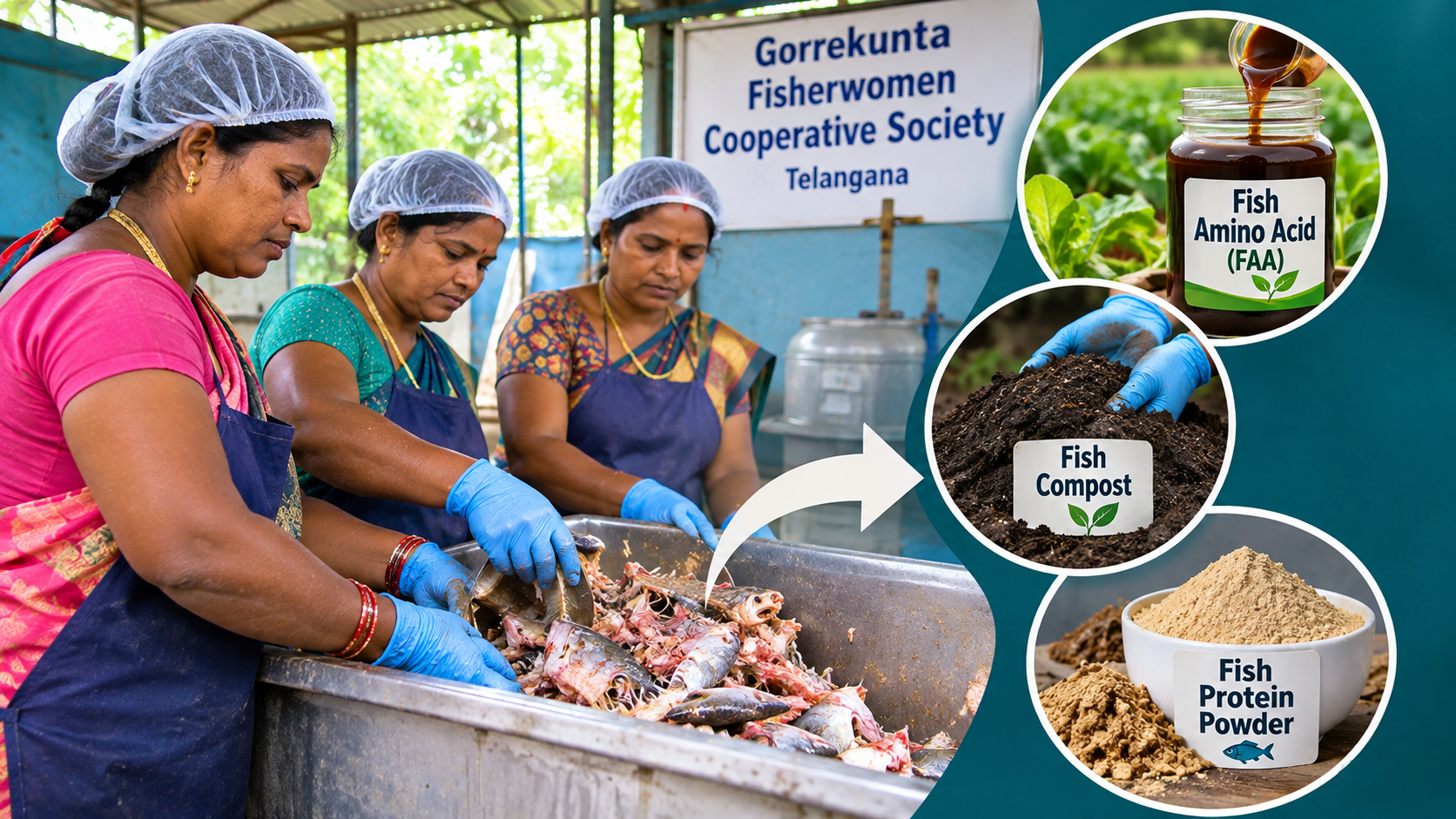
What happens to the fish heads, bones, skin, scales and entrails that are thrown away after fish are sold in markets?
Most of this material is treated as waste. It is dumped, creates foul smells and contributes to sanitation problems. But what if the same fish waste could be converted into organic fertiliser, compost and protein-rich feed ingredients?
An interesting initiative at Gorrekunta, near Warangal in Telangana, is exploring exactly this possibility. And the most interesting part? Local fisherwomen are at the centre of this transformation.
A small initiative with a bigger vision
Around three years ago, the Gorrekunta Fisher-women Cooperative Society started converting discarded fish-market material into useful agricultural products, with technical support from Prakriti Environment Society.
Their initial products were Fish Amino Acid, commonly called FAA, and organic fish compost.
The process begins with fresh fish waste. It is mixed with an equal quantity of jaggery and allowed to ferment for approximately 45 days. The mixture is stirred regularly. After fermentation, the liquid is separated, filtered and bottled as Fish Amino Acid.
The remaining solid material is retained and processed further into organic compost.
This simple experiment gradually attracted the attention of farmers, who showed interest in these products.
Laboratory testing of the existing Fish Amino Acid recorded 0.58% nitrogen, 5.13% calcium and 0.16% potassium, along with zinc and trace minerals. The product has a calcium-rich composition, although further improvements are needed to standardise its nutrient profile.
Three products from one resource
Now, the initiative is looking beyond liquid fertiliser and compost. The larger proposal is to establish an integrated fish-waste processing facility that can handle approximately one tonne of fish waste per day.
The proposed facility focuses on three products.
First, Fish Amino Acid.
Fish waste can be fermented and processed into a liquid agricultural input containing organic matter and nutrients. With improved fermentation, filtration and quality control, the existing product could be developed into a more consistent commercial formulation.
Second, organic fish compost.
The solid residue left after extracting the liquid can be mixed with suitable agricultural waste and carbon-rich materials. Through controlled composting and approximately six months of maturation, it can be converted into organic manure.
This means material that would otherwise be discarded can return to agricultural fields as a useful resource.
Third, fish protein powder.
This is perhaps the most interesting proposed product. Fish-processing waste contains valuable proteins, particularly in flesh, heads, skin and other protein-bearing portions.
Selected material can be segregated, dried, ground and processed into fish protein meal or powder.
An initial technical assessment of a dried fish-waste sample recorded approximately 41% crude protein. However, the sample also showed a high calcium-to-phosphorus ratio and potential microbial and heavy-metal concerns.
Therefore, this material cannot currently be recommended for human consumption. The opportunity being explored is a properly processed, tested and certified feed-grade product for aquaculture and animal-feed industries.
What is the scale of the proposed project?
The district administration has proposed allotting approximately two acres of land at Gorrekunta for expanding the initiative.
The preliminary project estimate is around ₹1.50 crore. At a proposed processing capacity of one tonne per day and approximately 300 working days annually, the facility could handle around 300 tonnes of fish waste every year.
However, these are proposed project figures, not confirmed operational production. The fish-protein processing section will also require a revised technical and financial assessment.
Why are fisherwomen important to this initiative?
Beyond the products, there is another important aspect: livelihood creation.
Fisherwomen are already involved in fish vending, cleaning, processing and marketing. But opportunities to participate in organised manufacturing and value addition remain limited.
A properly developed processing facility could give them an opportunity to become entrepreneurs, manage production, handle packaging and build their own market connections.
The Gorrekunta model could also inspire similar enterprises through fisherwomen cooperatives, fishermen’s societies and rural self-help groups in other fish-producing regions.
The challenges before expansion
The concept has potential, but scaling it up requires more than collecting fish waste and processing it.
Fermentation must be standardised. Compost quality needs to be tested. Protein products require proper processing and safety assessment. Microbial contamination, heavy metals, product consistency and wastewater management must all be addressed.
The three products also require separate raw-material allocation and proper production planning. Their actual yields and commercial viability need to be established through pilot trials.
CONCLUSION
Gorrekunta offers an interesting lesson for India’s fisheries sector.
Fish production does not end when fish reach the market. There is also value in what remains after processing.
Fish heads, bones, skin and other discarded materials could become agricultural inputs, compost and feed ingredients when recovered through appropriate processing.
What started as a small initiative involving local fisherwomen is now being explored as a larger resource-recovery enterprise.
Perhaps the next opportunity in fisheries is not just producing more fish, but finding better ways to utilise every part of the fish we harvest.
From fish waste to useful products, and from discarded resources to rural livelihoods — Gorrekunta is showing what this transformation could look like.
