
Standfirst
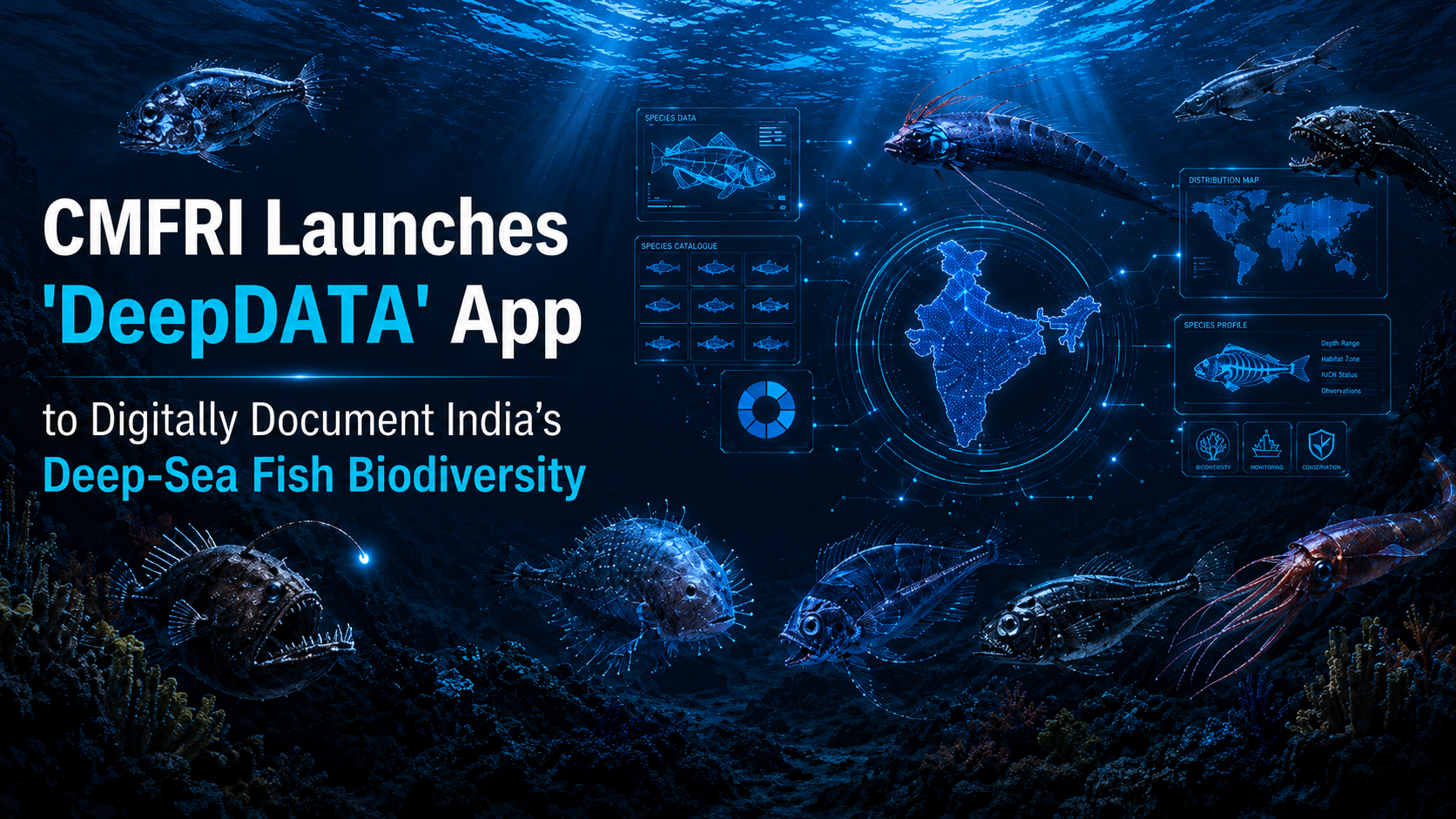
The ICAR-Central Marine Fisheries Research Institute (CMFRI) has launched DeepDATA, a new mobile application designed to create a scientifically verified digital repository of India’s deep-sea fish species. Developed under the Deep Ocean Mission, the app combines scientific research with citizen participation to improve biodiversity mapping, conservation, and sustainable management of India’s largely unexplored deep-sea ecosystems.
India has taken a significant step towards strengthening marine biodiversity documentation with the launch of DeepDATA, a mobile application developed by the ICAR-Central Marine Fisheries Research Institute (ICAR-CMFRI). The app enables users to access scientifically verified information on deep-sea fish species while also allowing them to contribute valuable field observations that will help build a comprehensive national digital database.
Developed under the Deep Ocean Mission with financial support from the Ministry of Earth Sciences, the application aims to bridge the gap between scientific research and public participation. Available on the Google Play Store, DeepDATA is expected to become an important digital resource for researchers, students, fishermen, and marine biodiversity enthusiasts interested in exploring India’s vast and largely undocumented deep-sea ecosystems.
A Digital Gateway to India’s Deep-Sea Biodiversity
India’s marine ecosystem is home to a remarkable diversity of deep-sea fish species, many of which remain poorly documented due to the challenges of studying habitats located hundreds or even thousands of metres below the ocean surface.
DeepDATA addresses this gap by providing users with access to detailed, scientifically validated information on deep-sea fishes found in Indian waters.
The application features high-quality photographs and comprehensive species profiles, including taxonomy, identifying characteristics, geographical distribution, and conservation status. This makes it not only a valuable scientific resource but also an educational platform for anyone interested in understanding India’s marine biodiversity.
By making verified scientific information easily accessible through a mobile application, CMFRI hopes to encourage greater awareness of the country’s deep-sea biological wealth.
Encouraging Citizen Science in Marine Research
One of the most innovative features of DeepDATA is its emphasis on citizen science.
The app allows users—including fishermen, researchers, students, and coastal visitors—to upload photographs and observations of deep-sea fishes encountered during fishing operations, research expeditions, or visits to coastal areas.
However, unlike open databases where information may remain unverified, every submission uploaded through DeepDATA undergoes scientific review by CMFRI experts before it is added to the national repository.
This verification process ensures that the information remains accurate, reliable, and scientifically authentic.
Once validated, these observations will contribute valuable data on species occurrence, geographical distribution, and biodiversity trends across Indian waters.
Fishermen Become Partners in Scientific Discovery
CMFRI believes that India’s fishing community can play a crucial role in improving knowledge about deep-sea biodiversity.
Speaking about the initiative, CMFRI Director Dr. Grinson George highlighted that fishermen regularly encounter species from offshore and deep-sea fishing grounds, making them important contributors to biodiversity documentation.
According to him, their field observations can provide researchers with valuable insights into the spatial distribution of species, the appearance of rare or lesser-known fishes, and possible changes in species occurrence over time.
Such information can significantly strengthen biodiversity conservation efforts while supporting the sustainable management of India’s marine resources.
By involving fishermen directly in scientific documentation, DeepDATA creates an opportunity for traditional knowledge and scientific research to work together in understanding India’s deep-sea ecosystems.
Bridging Science and Technology
The application has been designed to combine modern digital technology with marine science.
According to Dr. Eldho Varghese, In-charge of the IT Unit at CMFRI and the lead developer of the application, DeepDATA brings together scientific knowledge and field observations on a single digital platform.
The app not only makes reliable information on India’s deep-sea biodiversity more accessible but also strengthens national efforts to document marine resources that remain largely unexplored.
As more verified observations are added over time, the database is expected to become an increasingly valuable resource for researchers, fisheries managers, conservation agencies, and policymakers.
Supporting the Deep Ocean Mission
DeepDATA has been developed as part of India’s ambitious Deep Ocean Mission, a flagship initiative of the Ministry of Earth Sciences aimed at advancing deep-sea exploration, marine resource assessment, biodiversity conservation, and ocean technology development.
The mission seeks to improve scientific understanding of India’s Exclusive Economic Zone (EEZ), promote sustainable utilisation of marine resources, and strengthen the country’s capabilities in deep-sea research.
The launch of DeepDATA complements these objectives by creating a digital platform that can continuously collect and organise biodiversity information from across India’s marine waters.
Advancing Research and Conservation
According to Principal Scientist Dr. Rekha J. Nair, who leads the Deep Ocean Mission project under which the application was developed, DeepDATA bridges the gap between classroom learning and real-world marine biodiversity documentation.
She noted that the platform is expected to strengthen scientific research, improve biodiversity assessments, support conservation planning, and enhance public awareness about India’s deep-sea ecosystems.
With increasing pressures on marine environments from climate change, fishing activities, and habitat degradation, accurate biodiversity information has become essential for informed conservation planning.
Digital platforms like DeepDATA can provide researchers with long-term datasets that help monitor changes in species distribution and ecosystem health over time.
A Step Towards Sustainable Marine Resource Management
India’s deep-sea ecosystems remain among the least explored components of the country’s marine environment.
Despite supporting numerous commercially and ecologically important species, scientific information on deep-sea biodiversity remains limited compared to coastal ecosystems.
The launch of DeepDATA represents an important step towards addressing this knowledge gap by combining expert scientific validation with community participation.
As the national database expands, it has the potential to improve fisheries research, support evidence-based policy decisions, strengthen biodiversity conservation, and encourage sustainable utilisation of India’s marine resources.
By bringing together scientists, fishermen, students, and citizens on a common digital platform, CMFRI has created an innovative model for collaborative marine biodiversity documentation that could significantly enhance India’s understanding of its rich deep-sea ecosystems.
