
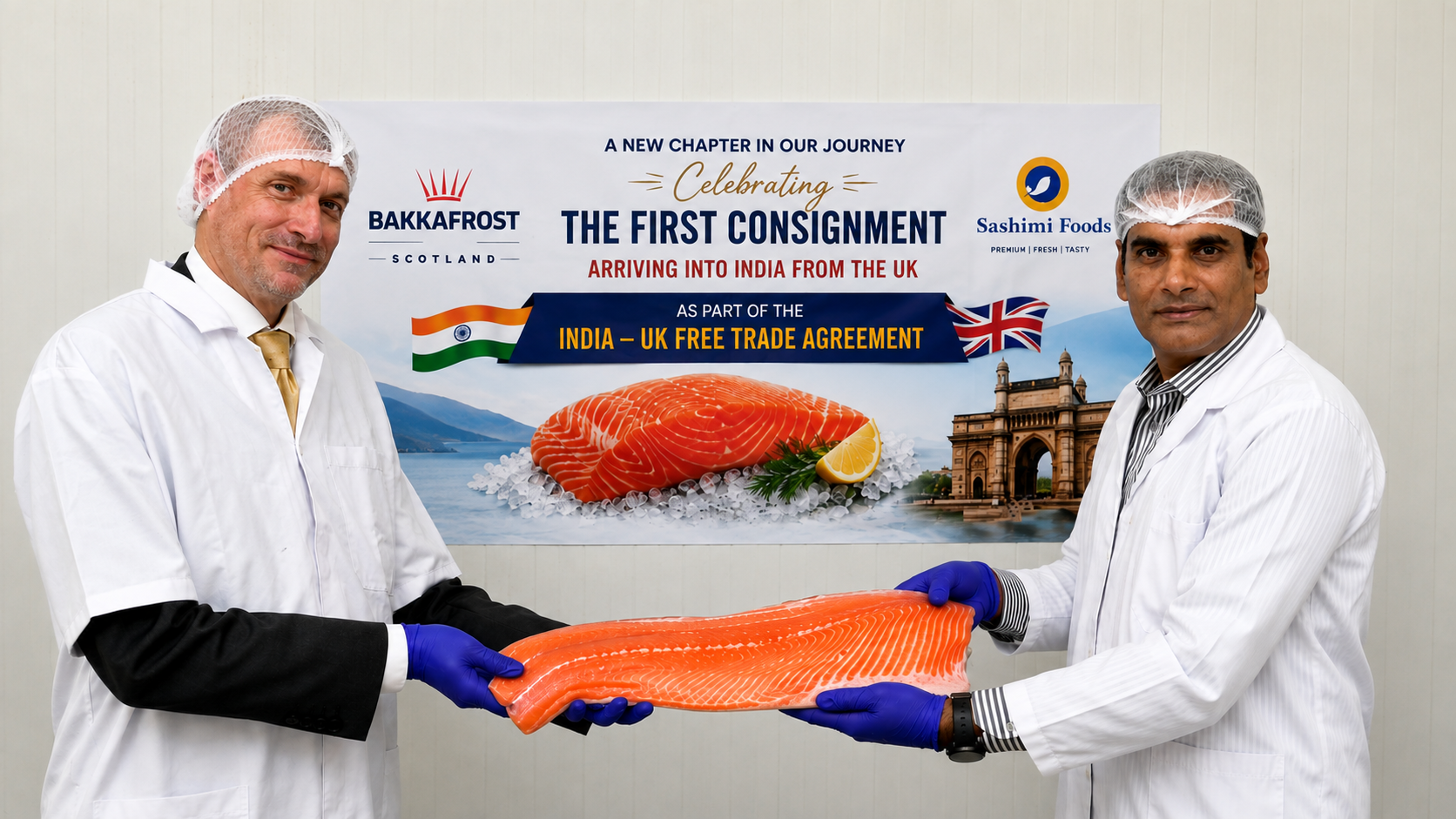
The first tariff-free shipment of Scottish salmon has arrived in India following the implementation of the UK–India Comprehensive Economic and Trade Agreement (CETA), providing one of the earliest commercial outcomes of the bilateral trade agreement.
The consignment comprised fresh farmed Scottish salmon produced by Bakkafrost Scotland and imported by Bengaluru-based Sashimi Foods Private Limited, one of India’s leading seafood companies. The shipment reached Bengaluru just two weeks after CETA came into force on July 15, 2026, reflecting how quickly businesses in both countries have begun utilizing the agreement.
The first sample consignment, valued at US$801.81, was formally received at the premises of Sashimi Foods by representatives of the British Deputy High Commission in Bengaluru. The shipment became possible after India removed its earlier 33% import tariff on Scottish salmon under CETA, improving market access for UK exporters while making premium Scottish salmon more competitive in India.
Scottish salmon is the United Kingdom’s largest food export and is internationally recognised for its premium quality. Industry estimates suggest that the trade agreement could generate up to £130 million in additional export opportunities for Scotland’s salmon sector over the next decade.
What is the UK–India Comprehensive Economic and Trade Agreement (CETA)?
The UK–India Comprehensive Economic and Trade Agreement (CETA) is a bilateral free trade agreement designed to strengthen economic cooperation between India and the United Kingdom by reducing tariffs, improving market access, and facilitating trade across multiple sectors.
Following several rounds of negotiations, India and the UK signed the agreement in July 2025, and it officially came into force on July 15, 2026, after completing the required ratification process.
The agreement covers trade in goods and services, investment, digital trade, government procurement, intellectual property, and professional mobility. By reducing or eliminating tariffs on thousands of products, CETA aims to boost bilateral trade, encourage investment, and create new business opportunities for companies in both countries.
For the fisheries and seafood sector, the agreement is considered one of the most significant recent trade developments, offering improved market access for exporters while creating new opportunities for seafood imports.
What Does CETA Mean for India’s Fisheries Sector?
While the arrival of Scottish salmon has attracted attention, the agreement’s larger significance lies in the opportunities it creates for India’s seafood export industry.
Under CETA, 100% of India’s marine exports receive duty-free access to the UK market, eliminating import duties of up to 20% on several seafood products. The tariff reduction is expected to improve the competitiveness of Indian seafood exporters and strengthen their presence in one of Europe’s premium seafood markets.
Among the major products expected to benefit are frozen shrimp, India’s largest seafood export commodity, along with Pacific White Shrimp (Litopenaeus vannamei), Black Tiger Shrimp (Penaeus monodon), frozen fish, squid, cuttlefish, lobsters, crabs, surimi products, fish oils, and a range of prepared and value-added seafood products.
For India’s shrimp farming sector, particularly in states such as Andhra Pradesh, Gujarat, Odisha, West Bengal, and Tamil Nadu, improved market access could strengthen export competitiveness and create additional opportunities for seafood processors and exporters. The agreement may also encourage greater investment in value-added seafood products to meet demand in the UK market.
As one of the world’s leading seafood-exporting countries, India is expected to benefit from improved access to the UK while diversifying its export destinations and strengthening long-term trade partnerships.
How Does the Agreement Benefit the UK?
The agreement also opens new opportunities for UK seafood exporters.
Before CETA came into effect, Scottish salmon attracted a 33% import tariff when entering India. The removal of this duty provides UK exporters with improved access to India’s growing premium seafood market and enhances the price competitiveness of Scottish salmon.
The first tariff-free shipment demonstrates that UK seafood companies are already beginning to utilise the agreement. With tariffs removed, exporters may expand supplies to India’s hospitality sector, premium retail outlets, restaurants, and specialty seafood distributors as consumer demand for imported seafood continues to grow.
The shipment also reflects the broader objective of CETA to facilitate two-way trade by reducing barriers and encouraging commercial partnerships across industries.
Looking Ahead
The first tariff-free shipment of Scottish salmon serves as an early indicator of how the UK–India Comprehensive Economic and Trade Agreement (CETA) could influence seafood trade in the coming years. While the immediate impact has been seen through the import of premium Scottish salmon, the agreement is expected to encourage greater participation from seafood exporters, processors, and importers on both sides.
For India’s seafood industry, the focus will now shift to how effectively exporters capitalize on duty-free access to the UK market. Expanding exports of value-added seafood products, strengthening supply chains, meeting quality and sustainability standards, and exploring new product segments could become key priorities as competition in international markets continues to grow.
At the same time, the agreement may encourage closer collaboration between Indian and UK seafood businesses in areas such as processing, cold chain infrastructure, technology, and product development. As trade volumes increase under CETA, the fisheries sector could emerge as one of the industries demonstrating the practical benefits of the agreement for both countries.
